China Travel Guide: Beautiful Places, Ancient Wonders + What to Know Before You Go
China can feel almost impossible to sum up in a single trip.
This is a country where ancient city walls sit alongside futuristic skylines, mist-covered mountains inspire paintings, high-speed trains race between enormous cities, and centuries-old villages still preserve traditions that seem far removed from modern urban China.
Then there are the places you already know by name. The Great Wall. Beijing. Shanghai. UNESCO treasures scattered across the country.
But some of China’s most memorable places lie beyond those familiar names.
You can wander beside rivers and limestone peaks in Guilin, explore the old lanes of Lijiang, discover extraordinary heritage sites across northern China, or stand among thousands of roses in Nanyang.
And then there is China itself.
The food. The tea. The landscapes. The architecture. The history. The sheer scale of the country.
This China travel guide is your starting point. Use it to discover where to go, find ideas for your itinerary, and understand a few important things before you arrive.
Discover Lijiang Old Town, China
Why Visit China?
Few destinations offer this much variety within one country.
China has more than 5,000 years of recorded cultural history, yet some of its cities feel decidedly futuristic. You could spend the morning exploring an imperial palace and the evening looking across a skyline illuminated by skyscrapers.
However, the landscapes may surprise you even more.
There are karst mountains, rice terraces, dramatic gorges, deserts, tropical beaches, ancient water towns and mountain villages. Add regional cuisines that change dramatically as you cross the country, and China becomes somewhere you could return to many times without repeating the same trip.
For a first visit, don’t try to see everything.
Instead, choose a few regions and experience them properly.
When Is the Best Time to Visit China?
This depends enormously on where you’re going.
China is simply too large for one universal “best month.”
However, spring and autumn are often excellent starting points for itineraries covering major cities and cultural attractions because temperatures can be more comfortable than during the hottest summer months or coldest winter periods.
Also look at Chinese public holidays before booking.
Major national holiday periods can bring exceptionally heavy domestic travel, fuller trains and crowded attractions.
China City Break Ideas
You don’t necessarily need several weeks to get a taste of China.
Major cities work surprisingly well as individual stops, especially because China’s extensive high-speed rail network makes it possible to connect several destinations without flying.
Beijing offers imperial history and access to the Great Wall. Shanghai delivers a very different experience with its historic Bund and modern skyline. Meanwhile, cities such as Xi’an, Chengdu, Hangzhou and Guangzhou introduce entirely different landscapes, cuisines and histories.
If you’re deciding where to start, I have already narrowed down some of the possibilities.
Start here:This Is China’s Top 15 City Break Destinations
China Travel Planning: What to Know Before You Go
China becomes much easier to navigate when you prepare a few things before leaving home.
And there are several practical differences that can catch first-time visitors by surprise.
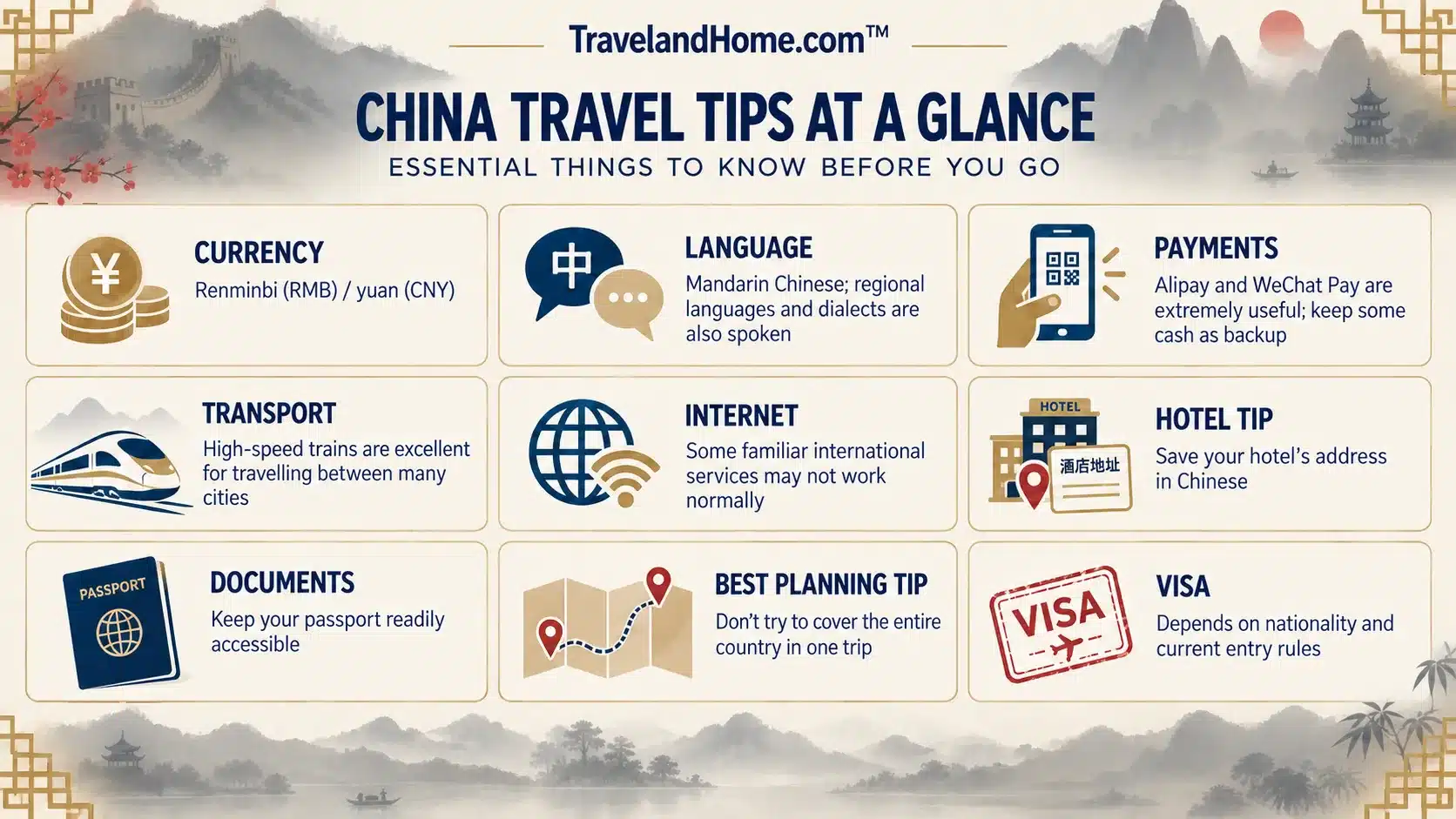
What Currency Does China Use?
Mainland China uses the renminbi (RMB), with the yuan (CNY) as its principal unit.
You’ll often hear prices simply described as “yuan.”
Hong Kong and Macao have their own currencies and payment systems, so don’t assume everything works exactly as it does on the mainland.
Language
Mandarin Chinese is the country’s official language, while numerous regional languages and dialects are also spoken.
English levels vary considerably.
Large international hotels and major attractions are generally easier to navigate. However, once you move beyond those environments, translation tools become very useful.
Download Chinese language support for your preferred translation app before leaving home.
Also save important place names in Chinese.
Money and Paying in China
This is one of the most useful things to prepare before your trip.
China relies heavily on mobile payments.
Alipay and WeChat Pay are widely used, and overseas visitors can link eligible international cards, including Visa and Mastercard, to these platforms. Cash and bank cards remain payment options too, although international card acceptance varies between businesses.
My advice would be simple:
Set up your payment options before you leave home.
Download the apps you intend to use, complete any required verification, and connect your card while you still have easy access to your bank and normal mobile number.
Also carry some Chinese yuan as backup rather than relying exclusively on your phone.
Getting Around China
China’s rail network makes travelling between major destinations remarkably practical.
High-speed trains connect many cities, while metro systems operate across dozens of urban areas. Government guidance says foreign visitors can purchase metro tickets at stations and, in many places, use services such as Alipay and WeChat for public transport.
For longer journeys, high-speed rail can often make more sense than flying once you factor in airport transfers and waiting times.
Keep your passport accessible. You may need it when booking or using transport services.
Internet Access in China
China’s internet environment differs significantly from what you may use at home.
Several international websites and services may not work normally on mainland Chinese networks. Therefore, don’t arrive assuming every app you normally rely on will remain available.
Before departure, download essential booking confirmations, hotel addresses, tickets and travel documents.
Screenshots can be surprisingly useful.
Get Your Hotel Address in Chinese
Here is one of those tiny preparations that can save a surprisingly large amount of stress.
Before leaving your hotel, keep its name, telephone number and address written in Chinese characters on your phone.
Then, if you need a taxi or directions, you can simply show the address.
Don’t rely only on an English hotel name.
Entry Requirements and Visas
Always check the rules that apply to your passport, not simply the country where you live.
China has expanded visa-free entry significantly. As of September 2026, ordinary passport holders from a long list of countries can enter China visa-free for tourism and certain other purposes for up to 30 days, with the current policy running through December 31, 2026. The list includes Hungary, the UK, Canada, Australia, New Zealand and many European countries.
Other nationalities may still need a visa.
China also operates a 240-hour visa-free transit program for eligible nationalities and qualifying journeys to a third country or region. The program now covers 65 ports, following another expansion in August 2026.
Because these policies change, check the current entry requirements shortly before booking and again before departure.
If this is your first visit, resist the temptation to collect cities.
Instead, build your trip around contrasting experiences.
You might combine Beijing and the Great Wall for China’s imperial story, then travel south to experience the scenery around Guilin and Yangshuo.
Alternatively, add Lijiang and Yunnan for old-town atmosphere and spectacular landscapes.
That gives you something far more memorable than racing between six or seven major cities.
China rewards time.
Sometimes the best part isn’t another famous landmark. It’s sitting down for tea, walking through a neighborhood market, taking an evening stroll beside a river, or ordering something from a menu when you’re not entirely sure what will arrive.
Your journey doesn’t have to end when you unpack your suitcase.
Chinese interiors and traditions offer beautiful ideas that can quietly find their way into your own home.
You don’t need to create a themed room. In fact, subtle details often work better.
Try a blue-and-white porcelain vase filled with fresh branches, a beautiful Chinese tea set displayed on a wooden tray, red or deep burgundy accents, bamboo accessories, silk-inspired cushions or a simple paper lantern.
Then bring China home through the kitchen.
Learn to make dumplings together. Experiment with ginger, sesame, soy, garlic and spring onion. Brew Chinese tea properly and serve it from a small pot rather than an everyday mug.
Suddenly, the places you’ve explored become more than photographs.
They become flavors, colors and little rituals that remain part of your life long after you return home.
Explore the world. Bring its beauty home.
Keep Exploring China
Right now, you can explore the Great Wall, Guilin, Lijiang, North China’s UNESCO treasures, Nanyang’s World Grand Rose Garden, China’s best city-break destinations and one very unexpected Santorini-inspired escape.
And as we discover more remarkable corners of China, you’ll find them added here.
So bookmark this China travel guide and come back when you’re planning your next adventure.