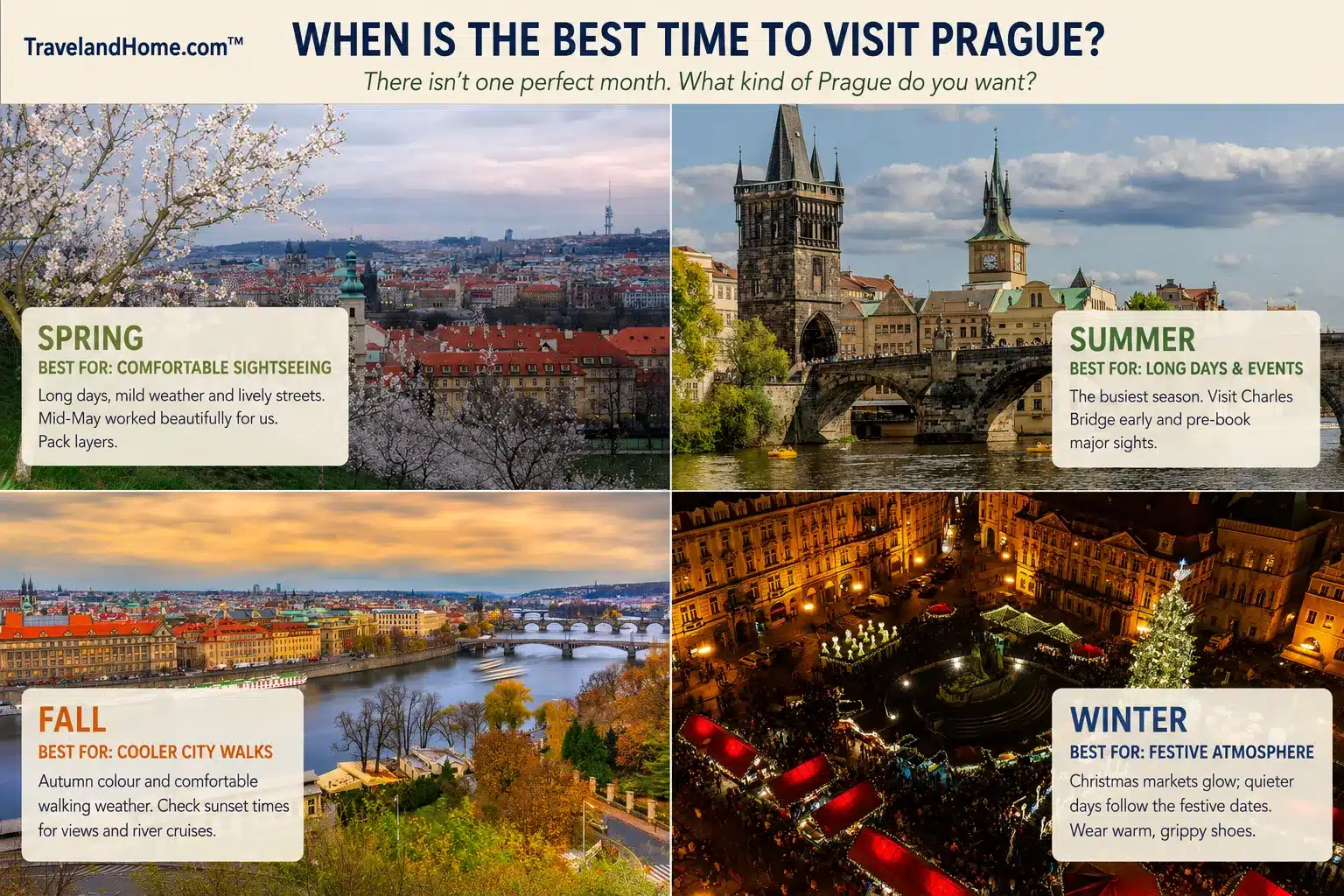
Prague is one of those cities that looks wonderfully manageable on a map. Then you arrive.
You cross Charles Bridge, spot another beautiful street, wander into a church, stop for photographs, find a little square you weren’t looking for… and suddenly half the day has disappeared.
I learned quite quickly that Prague is not a city you need to conquer. It’s a city you need to understand. Once you know how the different areas fit together, how the public transportation works, where to stay, and what is realistic in a day, Prague becomes remarkably easy to explore.
>> Prague’s historic core isn’t just beautiful — it’s officially recognized. The Historic Centre of Prague has been a UNESCO World Heritage Site since 1992, spanning architecture built between the 11th and 18th centuries across the Old Town, Lesser Town and New Town.
So, this isn’t another list of Prague’s top attractions. We have separate guides for those.
Think of this as the practical guide I would have liked before my first visit — the things worth knowing before you go to Prague.
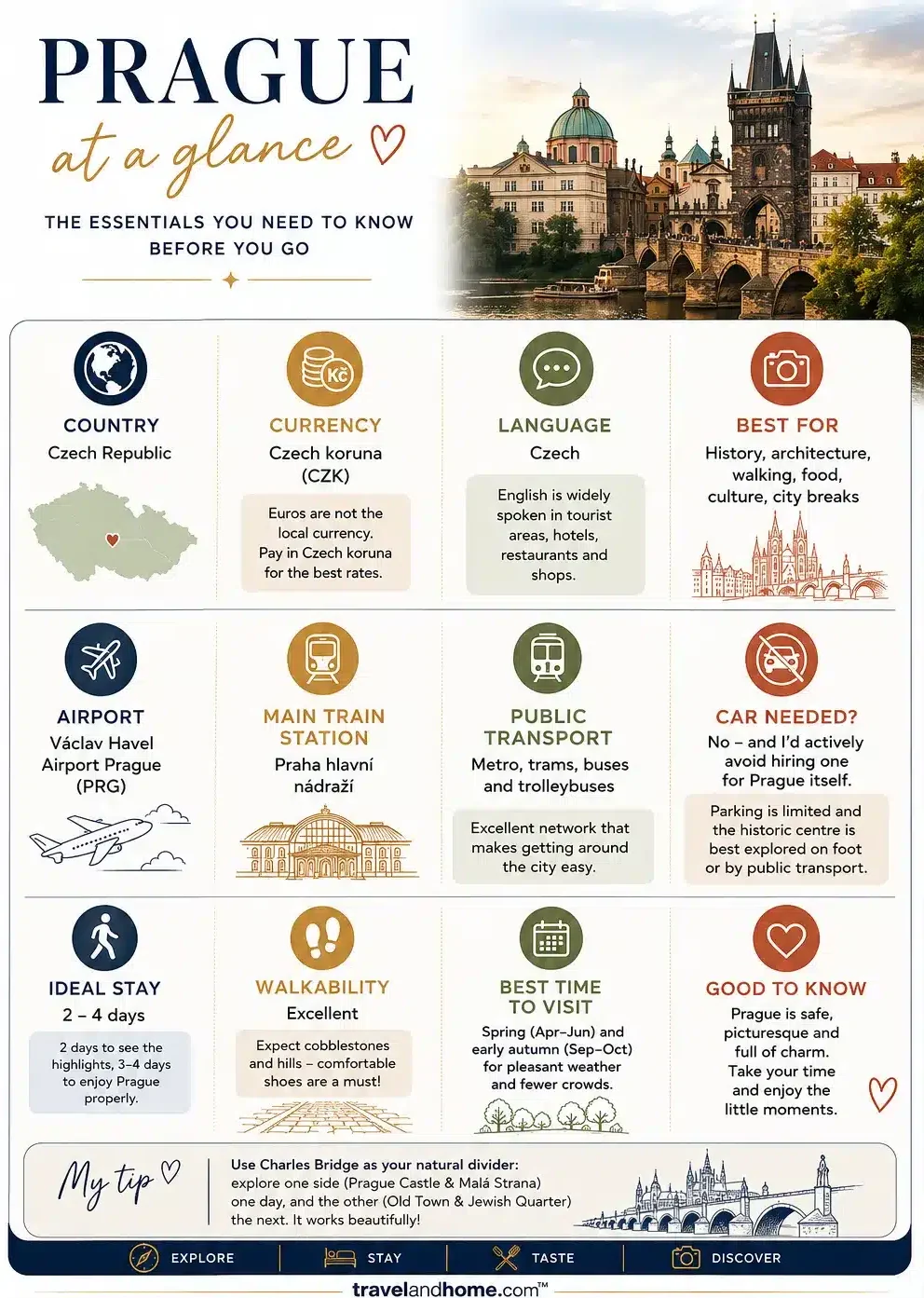
If you control your itinerary, I wouldn’t try to squeeze Prague into one day. You can see something worthwhile in a day. However, there’s a difference between seeing Prague and enjoying Prague.
For a first visit, I think two to four days works far better.
Choose an area and enjoy it properly.
Trying to cover Prague Castle, Malá Strana, Charles Bridge, Old Town, the Jewish Quarter, museums, churches and a river cruise in a single day turns sightseeing into a race.
That’s not how I’d recommend seeing Prague.
This is where Prague starts becoming much more comfortable.
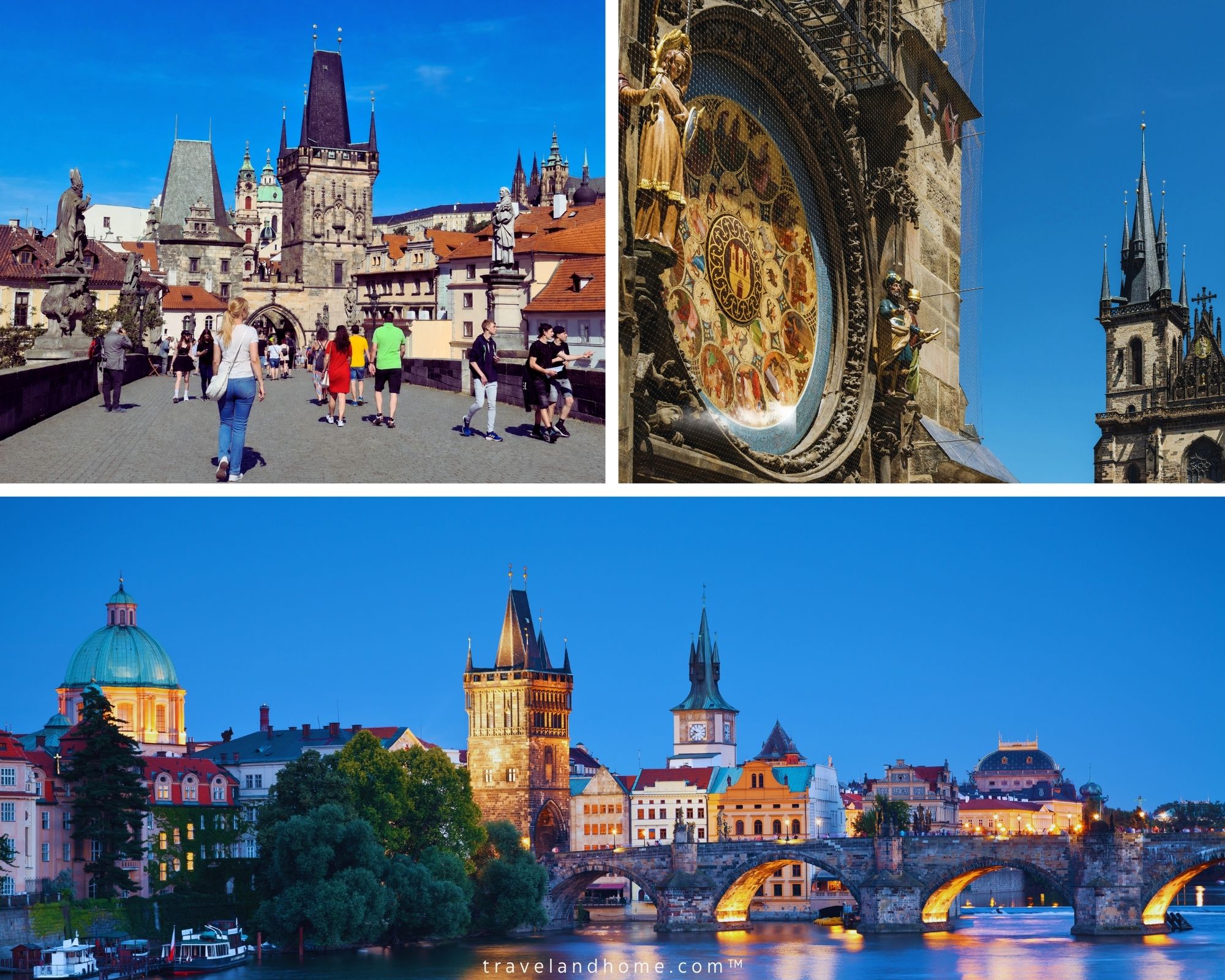
Charles Bridge became a natural dividing line for me.
I spent time exploring Malá Strana and the Prague Castle side separately from Old Town and the Jewish Quarter on the other side.
That worked beautifully.
Rather than constantly crossing backwards and forwards, you can concentrate on one part of Prague and actually notice what you’re walking past.
>> Planning the Castle side? Read our St. Vitus guide before you go.
>> Planning the other side of Charles Bridge? Follow our one-day Prague Old Town and Jewish Quarter walking itinerary.
Lovely.
Now you have room for an experience rather than another marathon sightseeing day.
Take a Vltava River cruise. Try a vintage-car sightseeing tour. Explore another neighborhood. Sit somewhere beautiful over coffee without looking at your watch every three minutes.
I took both a vintage-car tour and an evening dinner cruise during my stay, and they gave me completely different views of Prague.
Now I’d start looking beyond central Prague.
You could add another neighborhood, slow your sightseeing right down or take a day trip from the city.
One of my excursions was to Plzeň for the Pilsner experience — a completely different day from churches, castles and cobblestones.
>> Read about our Pilsner experience from Prague if you’re considering adding it to your trip.
One of Prague’s advantages is how easily it fits into a European itinerary. You can arrive by plane, train, international coach, or car.
Václav Havel Airport Prague (PRG) is Prague’s international airport.
There isn’t a metro station directly beneath the airport, which is useful to know before you arrive and start looking for one. Instead, public transportation connects the airport with Prague’s metro network.
You have several choices.
For many independent visitors, this will be the most economical option.
Trolleybus 59 connects the airport with Nádraží Veleslavín, where you can change to Metro Line A toward central Prague.
Another option is Bus 100 to Zličín, which connects with Metro Line B.
If your hotel is close to a metro or tram stop, public transportation can be surprisingly straightforward.
The Airport Express (AE) is the simplest public transport option if you’re traveling between Prague Airport and the main railway station, Praha hlavní nádraží.
Unlike the regular airport buses and trolleybus, the Airport Express is not covered by Prague’s ordinary public transport tickets or passes. You need to buy a separate Airport Express ticket.
You can buy the ticket at the Prague Public Transit information centers in Terminal 1 or Terminal 2, where Airport Express tickets are sold alongside ordinary public transport tickets.
>> Good to know if you’re 65+: Prague’s free public transportation for passengers aged 65 and over does not apply to the Airport Express. You’ll still need an AE ticket.
If your accommodation isn’t near the main railway station, the regular Trolleybus 59 + Metro A route may make more sense — and it uses Prague’s normal public transportation fare system.
This is the easy option if you’re arriving late, carrying substantial luggage, or simply don’t feel like working out public transportation after a flight. Sometimes convenience wins, right?
If I’ve been awake since some ridiculous hour of the morning and I’m dragging a suitcase behind me, I am perfectly capable of deciding that today is not the day for character-building public transportation.
Prague Airport’s official taxi service is Uber Airport. You don’t need to have the Uber app. You can book your ride in three ways:
through the Uber app
at a self-service kiosk at the airport
at the Uber Airport service counter in the arrivals hall
You’ll see the price before confirming your ride, and the official pickup points are directly outside the arrival halls at Terminals 1 and 2. Uber Airport cars are available 24 hours a day.
>> One useful caution: don’t accept unsolicited taxi offers from people approaching you at the terminal. Prague Airport specifically recommends using its official Uber Airport service rather than accepting rides offered by individuals outside the terminals.
Prague is particularly easy to combine with other Central European cities by rail.
The main station, Praha hlavní nádraží, is close to the center and connected to Prague’s public transportation network.
That makes the train an attractive option if Prague forms part of a longer European itinerary.
If you’re traveling between cities, compare the total journey rather than simply the scheduled travel time. A train that takes you from city center to city center can sometimes be far more convenient than flying once you add airport transfers and waiting time.
International coaches also connect Prague with destinations across Europe.
Florenc is one of Prague’s main bus terminals and has metro connections, which makes onward travel relatively simple.
As always, check the exact arrival point on your booking. Not every coach uses the same Prague station.
If you’re visiting Prague itself, I wouldn’t hire a car.
You simply don’t need one.
The historic center is wonderfully walkable, while Prague’s metro, tram and bus network can take over when the distance becomes too far or your feet decide they’ve had enough.
A rental car introduces parking, traffic, restricted areas and another thing to think about.
Why pay for a car to sit somewhere while you walk around Prague?
A car becomes more useful if Prague is only one stop on a wider Czech road trip and you want to explore places that are awkward to reach by public transportation.
Even then, I’d consider collecting the car after your Prague stay or returning it before spending your final days in the city.
If you’re arriving in Prague in your own car, look into Park & Ride options rather than assuming you’ll be able to park conveniently beside your Old Town hotel.
Prague is a fantastic walking city. In fact, walking is part of the experience. However, that doesn’t mean you should walk absolutely everywhere.
The city has an extensive public transportation network built around three metro lines, together with trams, buses and other services. My preferred formula would be:
Your feet will thank you.
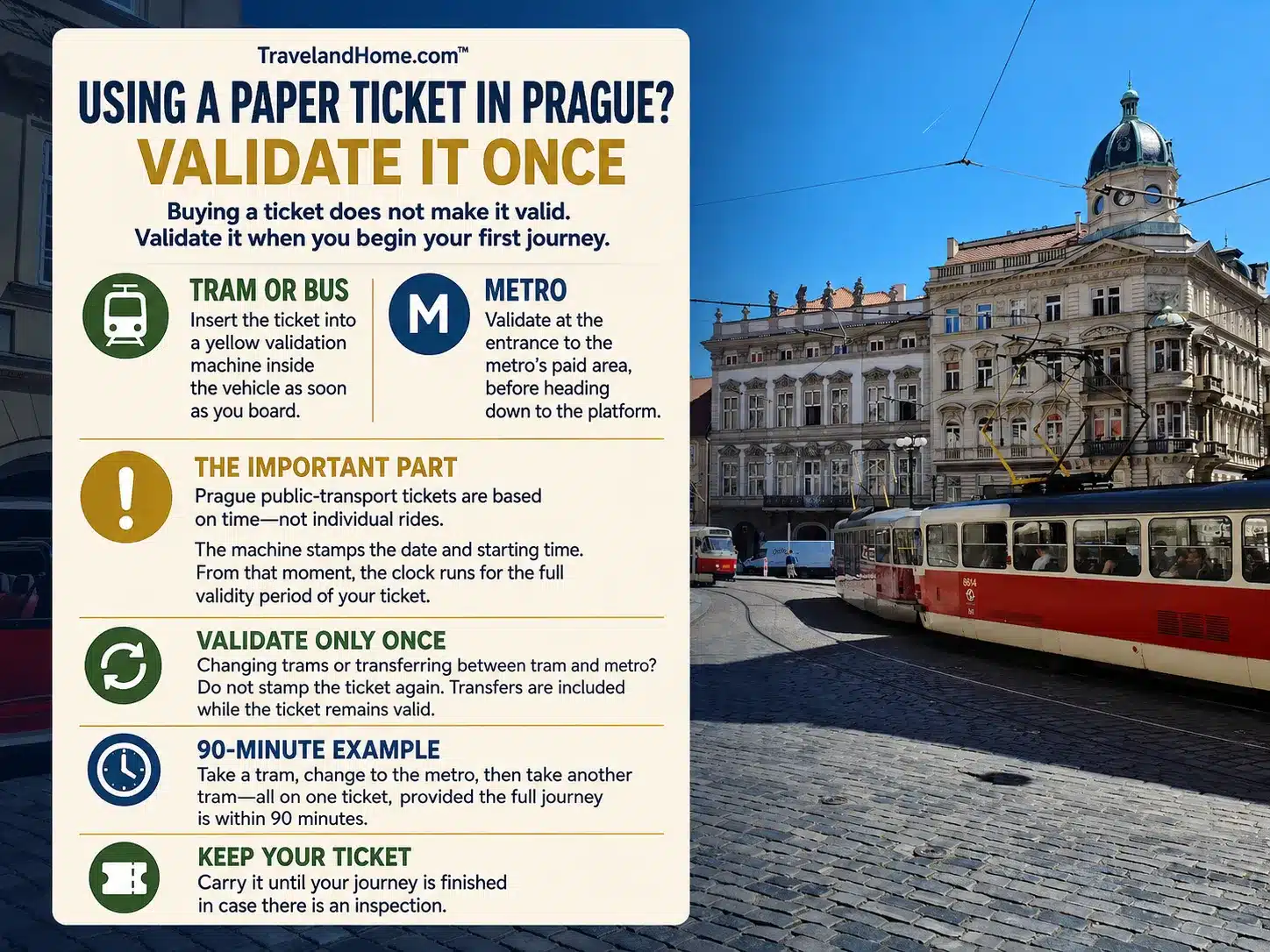
You don’t need separate apps for Prague’s metro and trams.
Download the PID Lítačka app, the official journey-planning app for Prague’s integrated public transportation system. It covers the metro, trams, buses and trolleybuses, so simply enter where you are and where you want to go. The app will work out the route, tell you where to change, show current departures and delays, and can even show the live location of your tram or bus.
You can also buy your Prague public transportation tickets directly in the app.
Prefer not to download another app? Use the official PID online journey planner instead. Enter your starting point and destination and it will plan the journey for you; you can even select only the type of transportation you want to use.
>> TravelandHome tip: If you see a tram coming and wonder, “Does that one go anywhere near my hotel?” — don’t guess. Put your destination into PID Lítačka and let the app do the Czech homework for you.
Yes — if you’re 65 or older, regular public transportation within Prague is free.
And here’s the really useful part for international visitors: you don’t have to be Czech. The free-travel benefit also applies to visitors from abroad. If you’re 65+, you can travel free on Prague’s regular:
Metro
Trams
Buses
Trolleybuses
Ferries
Simply carry your passport or another accepted photo ID showing your date of birth so you can prove your age if there’s a ticket inspection. You don’t need to buy a ticket for these regular Prague city services.
You don’t travel free yet, but you qualify for discounted fares within Prague.
As of 2026, the senior fares are approximately half the standard price, including discounted 30-minute, 90-minute and 24-hour tickets. You’ll need acceptable proof of age to use the discount.
Don’t assume the 65+ free-travel rule covers absolutely everything. The Airport Express (AE) between Prague Airport and the main railway station has a separate fare. Special historic transport services also have their own fares, while travel by train has additional requirements.
So, if you’re 65 or older and you’re simply sightseeing around Prague by metro, ordinary tram or city bus, this one’s easy: Keep your passport with you and enjoy the ride — it’s free.
Prague generally feels very comfortable to explore, including on foot. However, this is a busy European capital, so use normal city awareness.
Keep an eye on your belongings in crowded places and on public transportation. Be cautious around unsolicited currency exchanges. Use legitimate transportation services. And don’t leave your phone sticking invitingly out of an open bag while you’re concentrating on the Astronomical Clock.
Nothing dramatic. Just sensible city habits.
You don’t need a special Prague wardrobe, but there are a few things I’d definitely bring:
And leave a little space in your bag. Prague has a habit of sending you home with things you didn’t know you needed.
Prague is walkable. It is also cobbled. Those two facts need to live in the same sentence.
Wear comfortable shoes with decent support and grip, particularly if you’re planning full sightseeing days. This is not the city where I’d break in a beautiful new pair of shoes.
Some areas are also hilly, especially around Malá Strana and Prague Castle. If stairs or steep inclines are difficult for you, plan your public transportation route before setting out.
The Czech Republic uses the Czech koruna, abbreviated CZK. You may see prices written as Kč.
Although you may encounter businesses willing to accept euros, don’t build your spending plan around that. You’re in the Czech Republic. Plan to pay in Czech koruna.
Cards are widely useful, but I still like having a little local cash available for smaller purchases.
I encountered people offering currency around the Charles Bridge area. I didn’t use them. And I wouldn’t recommend that you do either.
If you need cash, use a legitimate bank, reputable exchange office or suitable ATM rather than accepting a street exchange from a stranger.
>> Travel and Home Tip: Pay attention when a card terminal or ATM offers to convert your payment into your home currency. Seeing the amount in familiar dollars, pounds or euros may feel reassuring, but the offered conversion rate may not be the best one. It’s still best to pay in the local currency. Read the screen before pressing buttons. Those few seconds can save money.
Where you stay can make an enormous difference to how much walking you do.
For a first visit, I’d think about what you most want outside your door.
Stay here if you want to be surrounded by historic Prague and within easy walking distance of many major sights.
It’s extremely convenient.
The trade-off? Popular central locations can also be busy.
This was a particularly useful location for the way I explored Prague.
You’re close to Charles Bridge, beneath Prague Castle and surrounded by beautiful historic streets.
It can feel wonderfully atmospheric, particularly once the busiest daytime crowds begin to disappear.
Don’t let the name fool you into picturing shiny modern skyscrapers.
Prague’s New Town isn’t exactly new.
Charles IV founded it in the 14th century.
It offers plenty of accommodation, restaurants, shopping and convenient transportation while still keeping you close to the historic center.
If you’d prefer to stay a little outside the busiest sightseeing core, Vinohrady is worth considering.
It has more of a residential feel while remaining well connected to central Prague.
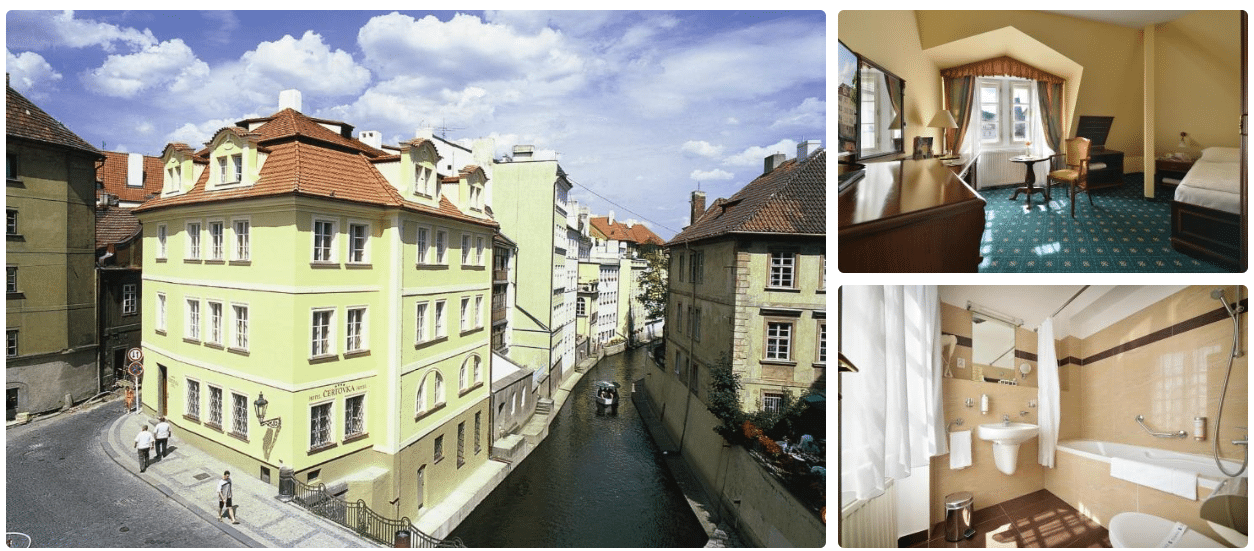
I stayed at Hotel Čertovka in Malá Strana, very close to Charles Bridge. Its location suited the way I explored Prague particularly well. I could spend one day concentrating on one side of Charles Bridge and another exploring the other side without wasting time traveling backwards and forwards across the city.
The hotel itself didn’t need to be the star of my Prague trip. Prague was. What I wanted was a convenient base, breakfast before I left for the day and somewhere comfortable to return to after sightseeing.
>> If you’re considering staying there, I’ve written a separate Hotel Čertovka Prague review based on my experience.
>> If you’d rather compare areas and accommodation first, head to our Prague hotel guide instead.
For ordinary wandering around Prague, no.
For something you would be genuinely disappointed to miss, I’d book or at least check ahead. That includes special tours, popular evening cruises, performances and attractions with timed entry.
Prague Castle deserves a special mention. The Castle is not simply one attraction with one front door. It’s an enormous complex containing historic buildings, courtyards, churches and visitor areas.
Opening times at Prague Castle can occasionally change for state events, operational reasons or religious services at St. Vitus Cathedral.
Buying your Prague Castle Main Circuit ticket online does not reserve a timed entry to each building, so an advance ticket doesn’t guarantee that every attraction on the circuit will be open when you arrive.
Before setting out, take a quick look at the official Prague Castle Current Closures page. It lists any temporary closures or reduced opening hours for St. Vitus Cathedral, the Old Royal Palace, Golden Lane and other parts of the Castle.
That one quick check is particularly worthwhile if there’s one building you would be disappointed to miss.
This confuses plenty of first-time visitors. You don’t need a sightseeing ticket simply to enter and walk through the main Prague Castle complex.
However, tickets are required for the paid historic interiors and visitor attractions included in the Castle’s sightseeing arrangements.
So don’t think: No ticket = no Prague Castle.
Instead, decide how deeply you want to explore. If St. Vitus Cathedral is high on your list, read our St. Vitus Cathedral Prague guide before you go. I’ve separated that information because the cathedral deserves far more than a passing paragraph here.
Once the practical decisions are sorted, then start building your sightseeing days.
That way, you don’t have to squeeze every Prague attraction into one enormous itinerary. Pick what appeals to you and build the Prague trip that suits you.
Plan the Practical Bits
Handy links for booking stays, getting around, and planning things to do.
🛌🏻 STAY
Agoda · Booking.com · Expedia · Vrbo
✈ 🚆 🚌 ⛴ ⛍ GET AROUND
OMIO · Travelstart · Trip.com · Car Hire
👀 THINGS TO DO
GetYourGuide · Viator · Tripadvisor
Final Thoughts: Prague Is Easier Than It First Appears
For all its towers, winding streets, complicated-looking Czech names and centuries of history, Prague is actually a wonderfully approachable city.
You don’t need a rental car. You don’t need to memorize the metro. And you certainly don’t need to see everything on your first visit.
Choose a good base. Bring comfortable shoes. Learn the basics of the public transportation system. Keep some Czech koruna handy. Divide your sightseeing into sensible areas.
Then leave enough space in the itinerary to get distracted. Because you will. A little lane will catch your eye. A church door will be open. You’ll stop on Charles Bridge longer than planned.
Have you been to Prague? What practical tip would you give someone planning their first visit? Or, if you’re heading there soon, what are you still trying to figure out? Drop your thoughts below — let’s chat!
Sharing the places I’ve come to love. – Arina ♡