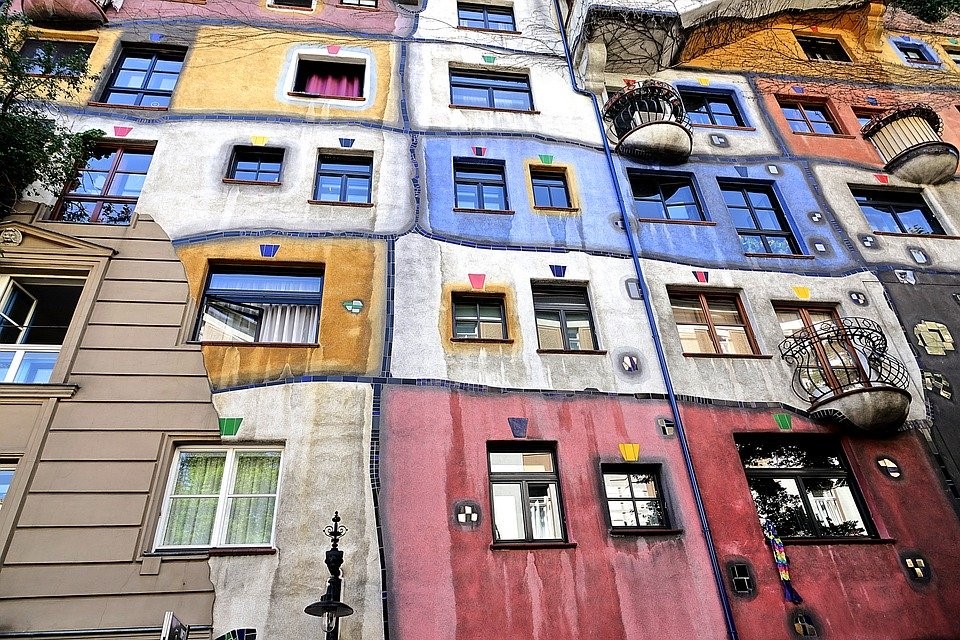
I love puzzles and even as an adult I love doing them. Therefore when I came across a puzzle with the Hundertwasser house photo, I just had to know more about this amazing architecture. As a result of my research, I’ve now decided to put the Hundertwasser buildings on my travel bucket list.
More about Hundertwasser
Friedensreich Regentag Dunkelbunt Hundertwasser, was an Austrian-born artist and architect.
According to Wikipedia: “Hundertwasser stood out as an opponent of “a straight line” and any standardization, expressing this concept in the field of building design. His best-known work is the Hundertwasserhaus in Vienna, Austria which has become a notable place of interest in the Austrian capital, characterized by imaginative vitality and uniqueness.”
Born on 15 December 1928, Hundertwasser was at first known for his bold colourfull paintings. In addition his individual architectural designs of irregular forms and natural features he took from the landscape surrounding his properties, made the Hundertwasserhause apartment block stand out. Undoubtedly different from the normal “dull” architectural styles everyone was used to. Surely an unusual design; like trees growing from the windows and floor levels that’s not level to the eye.
Apparently he took no payment for the design. Saying that it was worth the investment to “prevent something ugly from going up in its place”.
In the 1970s Hundertwasser bought land in New Zealand and built the “Bottle House”. Mostly self-sufficient with solar panels, water wheel and purification plant as well as a grass roof. Arguably the birthplace of many of his experiments; like the grass roof.
He died at the age of 71 in the year 2000 but definitely left a legacy of “thinking out of the box”. Still many years later people are talking about his designs.
The Hundertwasser House in Vienna, Austria (An apartment building)
Address: Kegelgasse 36-38, 1030 Wien, Austria
Hundertwasser house in Vienna, Austria. (A social housing complex of the municipality)
Idea and concept of Friendensreich Hundertwasser with architect Joseph Krawina as co-creator.
Can You Go Inside the Hundertwasser House?
Many first-time visitors expect to tour the famous Hundertwasserhaus, but it remains a functioning municipal apartment building. Because people live there, the interior is not open to the public. Visitors are encouraged to admire the building from the street and respect the privacy of its residents.
To experience Hundertwasser’s interiors and learn more about his life and ideas, visit KunstHausWien, where exhibitions showcase his artwork, architectural philosophy, and commitment to environmental design.
Tips for Visiting Hundertwasser’s Vienna
Visit early in the morning to enjoy the best light for photographs and fewer visitors.
Wear comfortable walking shoes, as the main attractions are easily explored on foot.
Allow extra time for KunstHausWien if you enjoy art and architecture.
Remember that Hundertwasserhaus is a private residential building, so please be respectful of the people who live there.
Public transport makes it easy to reach the Spittelau Waste Incineration Plant if you wish to see all of Hundertwasser’s major works in Vienna.
These remarkable buildings offer a fascinating glimpse into one of Austria’s most imaginative creative minds. Even visitors with little interest in architecture are often captivated by the cheerful colors, playful designs, and the way Hundertwasser blended nature with everyday urban life.
Visit Hundertwasser Village
Located directly across the street, this colorful shopping arcade was also designed in Hundertwasser’s style. You’ll find souvenir shops, cafés, and a public square with the same whimsical architecture.
Enjoy a coffee nearby. Several cafés around Hundertwasser Village provide a pleasant spot to relax while taking in the unique surroundings.
How long should you allow?
Plan to spend 30–45 minutes if you’re simply viewing and photographing the Hundertwasser House. If you also visit Hundertwasser Village and KunstHausWien, allow 2 to 3 hours.
A Self-Guided Hundertwasser Walk in Vienna
One of the easiest ways to experience Hundertwasser’s work is on foot.
Start at KunstHausWien, where you can explore the museum and gain insight into the artist’s life. From there, walk just a few minutes to Hundertwasserhaus, taking time to appreciate its colorful façade, curved lines, and tree-filled balconies. Continue to Hundertwasser Village for a coffee or browse the small shops before finishing your visit.
If you have more time, take public transport to the Spittelau Waste Incineration Plant to see another of Hundertwasser’s remarkable architectural projects.
Allow around 2 to 3 hours for the walking route, or longer if you plan to visit the museum.
The Kuchlbauer Tower, together with the Kuchlbauer KunstHaus (Art House), is the symbol of Kuchlbauer’s World of Beer in Abensberg, Germany. The tower was inspired by the ideas of Friedensreich Hundertwasser, who created the original design before his death in 2000. It was later completed under the direction of architect Peter Pelikan and opened in 2010.
The Waldspirale is a distinctive residential building complex in Darmstadt, Germany, designed by Friedensreich Hundertwasser. The striking building features a green roof planted with trees, shrubs, and grasses, giving it the appearance of a small forest. Visitors can admire the colorful architecture, explore the public courtyard, and take photos of one of Germany’s most unusual apartment buildings.
Address: Waldspirale, 64289 Darmstadt, Germany
Waldspirale, Darmstadt in Germany: None of the over 1000 windows of the building are the same. Each one is unique.
Is it worth a visit?
The Waldspirale is worth visiting if you enjoy unusual architecture or are already in Darmstadt. It is one of Friedensreich Hundertwasser’s last architectural projects and is unlike any other apartment building in Germany.
Here’s what you can expect:
Admire the striking façade with its curved walls, irregular windows, and colorful details.
Walk through the public courtyard and appreciate the building from different angles.
Photograph the rooftop, which is planted with trees, shrubs, and grasses, giving the building its name, “Forest Spiral.”
Notice that no two windows are exactly alike, reflecting Hundertwasser’s belief that architecture should celebrate individuality.
Keep in mind that Waldspirale is a residential apartment building, so you cannot enter the apartments or visit the rooftop garden. Most visitors spend 20 to 45 minutes exploring and taking photographs.
Is it worth making a special trip?
Yes, if you’re a fan of Hundertwasser, modern architecture, or unusual buildings.
Probably not if you’re looking for museums, guided tours, or interactive attractions.
If you’re travelling through southern Germany or combining Darmstadt with Frankfurt, it’s an interesting stop that offers a very different perspective on architecture.
If you have to choose only one Hundertwasser attraction, however, Hundertwasserhaus in Vienna offers a richer visitor experience thanks to the nearby Hundertwasser Village and KunstHausWien museum.
These buildings are all unique. Definitely something to put on your travel itinerary as “unique places” to visit.
Visit the Hundertwasser Museum in Vienna
In Austria and Germany
It is worth highlighting the following eight buildings because they are among the most interesting and accessible for travelers:
Hundertwasserhaus – Vienna, Austria
KunstHausWien – Vienna, Austria
Waldspirale – Darmstadt, Germany
Green Citadel – Magdeburg, Germany
Rogner Bad Blumau – Austria
Kuchlbauer Tower – Abensberg, Germany
Uelzen Railway Station – Germany
Spittelau Waste Incineration Plant – Vienna, Austria
DID YOU KNOW: Quixote Winery, Napa Valley, California
This is the only building designed by Hundertwasser in North America. The winery features his trademark flowing lines, colourful walls, and playful forms, making it a unique destination for architecture lovers visiting California wine country.
Hundertwasser’s buildings are far more than colorful landmarks. They invite you to see architecture through a different lens, where nature, creativity, and individuality take the place of straight lines and uniform design. Every building tells its own story, offering unexpected details that reward curious visitors. From Vienna to Darmstadt, Magdeburg, Abensberg, and beyond, these remarkable creations prove that even everyday places can become works of art. If you enjoy discovering destinations that are unlike anywhere else, a journey through Hundertwasser’s world is one you won’t soon forget.