
I thought I had bought the perfect cabin bag. It was a quality American Tourister measuring 55 × 40 × 20 cm. Then I booked Ryanair and realised my brand-new suitcase was apparently ‘too big’. Had I wasted my money?
I thought I had done everything right.
Before flying from Budapest to Bari on Ryanair, I treated myself to a beautiful new American Tourister cabin bag. It measured 55 × 40 × 20 cm, which I believed was the standard cabin size. It looked smart, rolled beautifully, and I imagined it would become my trusted travel companion for years to come.
Then, while checking my booking a little more carefully, I noticed something that completely changed my plans.
My ticket only included one free under-seat bag measuring 40 × 30 × 20 cm.
My brand-new cabin suitcase was suddenly too big.
For a moment I wondered if I had wasted my money.
Fortunately, I hadn’t. I simply misunderstood something that catches out thousands of travellers every day.
Instead of taking my lovely new suitcase on that trip, I bought a smaller bag that met Ryanair’s free baggage allowance. I chose one in a similar colour so they looked like they belonged together. Since then, I’ve realised that owning two different cabin bags is actually one of the smartest travel decisions you can make.
If you’ve ever stood in a luggage shop wondering which cabin bag to buy, or worried that your suitcase might be too big at the boarding gate, this guide is for you.
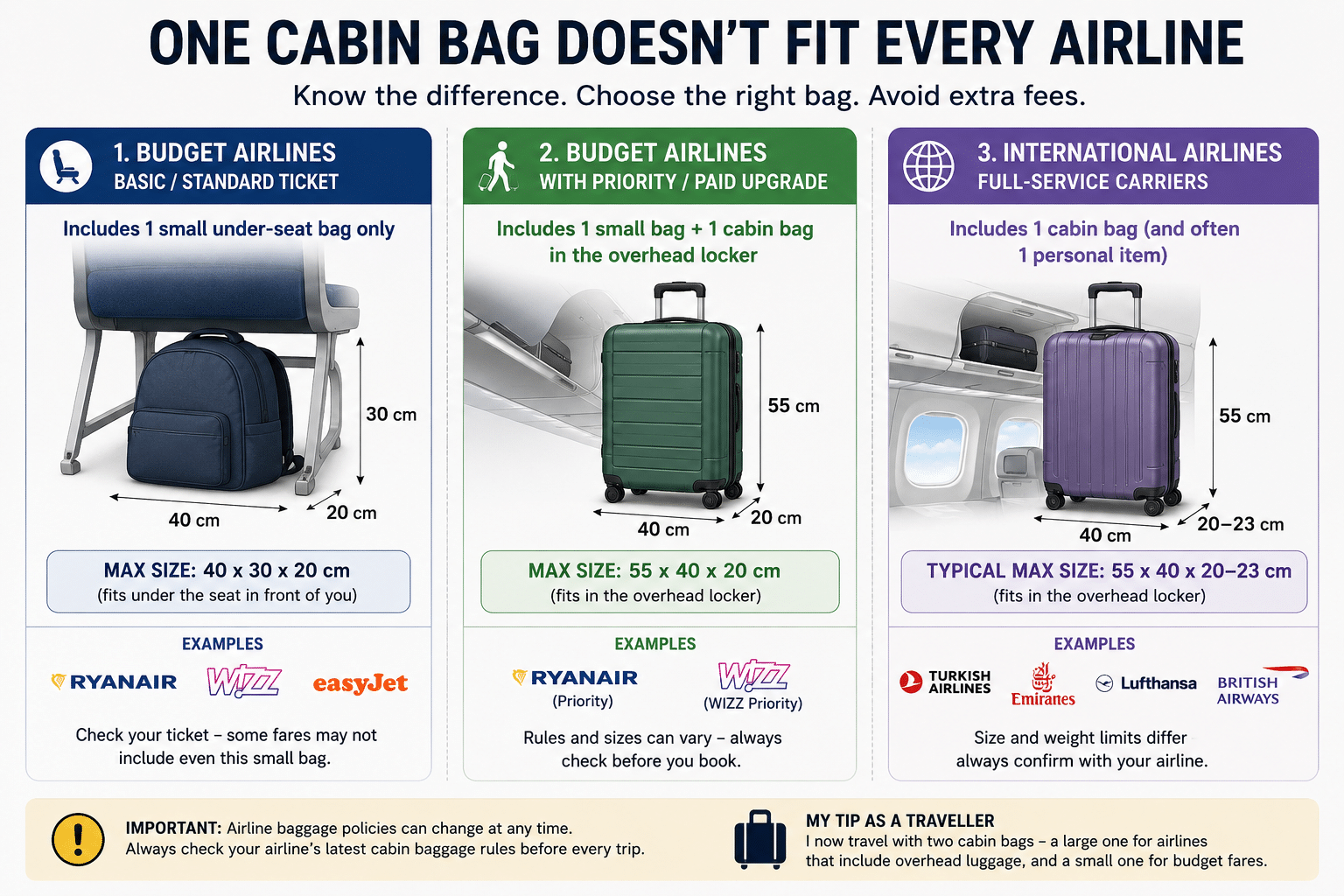
Many travellers assume that luggage manufacturers are behind the times because so many low-cost airlines now advertise much smaller free baggage allowances.
They’re not.
The 55 × 40 × 20 cm cabin bag remains one of the most widely accepted overhead cabin luggage sizes in the world. Full-service airlines continue to allow it because it fits comfortably into the overhead lockers on most aircraft.
Manufacturers such as American Tourister and Samsonite design luggage for the widest possible range of airlines, not just one or two budget carriers.
Your 55 cm suitcase isn’t outdated. It simply serves a different purpose.
Many people think there’s an international standard.
There isn’t.
Every airline decides for itself:
That’s why one airline welcomes your suitcase while another charges you extra for exactly the same bag.
Years ago, almost every airline included a cabin suitcase in the ticket price.
Then, low-cost airlines changed their business model.
Instead of increasing ticket prices, they began charging separately for extras like:
The cheapest fares now usually include only a small bag that fits under the seat in front of you.
That’s why so many travelers become confused when shopping for luggage.
| Airline | Free under-seat bag | 55 × 40 × 20 cm overhead bag |
|---|---|---|
| Ryanair | ✔ (40 × 30 × 20) | ✔ with Priority |
| Wizz Air | ✔ (40 × 30 × 20) | ✔ with WIZZ Priority |
| easyJet | Depends on fare | Usually yes with larger cabin allowance |
| British Airways | Included | ✔ |
| Lufthansa | Included | ✔ |
| Turkish Airlines | Included | ✔ |
| Emirates | Included | ✔ |
Travel and Home Tip
Airline baggage policies can and do change. While I’ve researched the information in this guide carefully, always double-check your airline’s latest cabin baggage allowance before you travel. A quick look at the airline’s website can save you unexpected fees and unnecessary stress at the airport. Even if you’ve flown with the same airline before, don’t assume the rules are still the same.
Explain that many European low-cost carriers now include only:
Then remind readers that rules change regularly, so always check before flying.
This was the lesson I learned.
Instead of trying to find one magical suitcase that works for every airline, many experienced travellers own:
Bag One
A quality 55 cm cabin suitcase for airlines that include overhead luggage.
Bag Two
A lightweight under-seat backpack or small cabin bag that fits budget airline rules.
Since buying my second bag, I no longer stress about baggage allowances. I simply choose the bag that matches the airline and ticket I’ve booked.
Ask yourself:
Do you mostly fly with Ryanair or Wizz Air?
→ Buy a 40 × 30 × 20 cm under-seat bag first.
Do you mostly fly internationally?
→ Invest in a quality 55 cm cabin suitcase.
Do you fly both?
→ Buy both.
Recommended: Under-seat cabin bags (40 × 30 × 20 cm)
Recommended: 55 cm cabin suitcases
Recommended: Cabin luggage sets
Choosing the right cabin bag is only part of traveling smarter. I’ve also put together my favorite travel luggage tips to help you choose durable luggage, pack efficiently, and avoid some of the mistakes many travelers make before their trip.
After discovering that one cabin bag doesn’t suit every airline, I also realized how much easier traveling became once I organized everything properly. These are the travel accessories that now come with me on almost every trip.
People often ask me which cabin bag I recommend. The honest answer is that I don’t have just one.
I now own three cabin bags, and I choose the one that best suits the airline I’m flying with.
My American Tourister 55 × 40 × 20 cm is my first choice whenever my ticket includes an overhead cabin bag. It’s sturdy, easy to manoeuvre, and perfect for longer trips.
My smaller hard-shell 40 × 30 × 20 cm cabin bag comes with me on budget airlines when I need to fit my luggage under the seat. Because I almost always travel with my laptop, I appreciate the extra protection a hard-shell case provides.
My soft-sided 40 × 30 × 20 cm bag is ideal when I want a little more flexibility. It can be easier to squeeze under the seat, and I find it handy for shorter trips when I’m packing light.
I’ve learned that there isn’t one perfect cabin bag. There is only the right cabin bag for the airline you’re flying with.
Yes. It remains one of the most widely accepted overhead cabin luggage sizes.
Because your ticket probably includes only the free under-seat bag, not the overhead cabin allowance.
That depends entirely on which airlines you fly most often.
Yes, but you’ll usually need to purchase Priority boarding or another fare that includes an overhead cabin bag.
Almost certainly not. It’s likely to be accepted on many airlines around the world. You may simply need a second, smaller bag for some low-cost flights.
My American Tourister cabin bag certainly wasn’t a bad purchase. It simply wasn’t the right bag for that particular Ryanair ticket. Today, I own two cabin bags and choose the one that suits the airline I’m flying with. It has made travelling far less stressful.
One final tip: airline baggage policies can change at any time. Before every trip, take a minute or two to check your airline’s latest baggage rules. That small habit can help you avoid extra charges, last-minute surprises at the boarding gate, and the disappointment of discovering your carefully chosen cabin bag isn’t the right one for your ticket.
I hope my experience helps you choose the right cabin bag the first time. If it saves you from making the same mistake I did, then my unexpected lesson in Budapest will have been well worth sharing.
Sharing the places I’ve come to love. – Arina ♡