
I have called Szeged home for the past seven years, and somewhere between the tree-lined boulevards, the relaxed café culture, and countless walks along the Tisza River, this sunny Hungarian city quietly became part of my heart. It may not appear on every traveler’s bucket list, but that’s exactly what makes it so special.
I’ve watched the city change with the seasons, celebrated its vibrant festivals, discovered hidden corners far from the usual sightseeing routes, and found favorite places that I still return to time and again. Living here has given me the chance to experience Szeged beyond its famous landmarks. I’ve come to appreciate its welcoming atmosphere, beautiful architecture, and the slower pace of life that encourages you to linger just a little longer.
This guide isn’t just a collection of attractions. It’s a local’s perspective on the places, experiences, and little discoveries that make Szeged worth visiting. Whether you’re planning a weekend getaway, passing through southern Hungary, or simply looking for somewhere different to explore, I hope you’ll come to love this city as much as I have.
Best Time
Getting There
Is Szeged Expensive?
The length of the day in Szeged varies significantly over the course of the year. For instance, the shortest day is December 21, with 8 hours, 36 minutes of daylight. In contrast, the longest day is June 20, with 15 hours, 47 minutes of daylight.
Summer has beautiful, warm, sunny days between June and August, generally ranging from the upper 20s to around the mid-30s. Lately, even reaching the upper-30s. The humidity in July/early August can be quite high, sometimes exceeding your comfort level. For instance, 80% plus.
In autumn (September to November), you have warm, autumn-colored leaves (especially around the end of October/mid-November) putting on a spectacular display.
Winter is most definitely not a season for tourism in Hungary. Days are grey; there’s little sunshine; daylight hours are short; and it is cold. In addition, most noteworthy attractions close during the winter months.
Budapest Ferenc Liszt International Airport (IATA: BUD, ICAO: LHBP), is commonly known as Budapest Airport.
Szeged has a small airport about 5km west of the city. The airfield is mostly used for private chartered jets and shows.
With normal traffic, it takes about two hours by car from Budapest, depending on conditions. Most of the road trip is on highways.
Szeged has an excellent public transport infrastructure, consisting of bus, tram, and taxi services.
From the airport, book a transfer service with Zöld Transfer. They are reliable, and it’s the service that the locals use.
The official currency in Hungary is the Hungarian Forint (HUF). Mastercard and Visa cards are accepted, as well as cash payments in Euros. When you’re in Szeged, make sure you exchange some of your Euros for Hungarian Fortin (HUF). The alternative is to use your card. It is seldom that Euros are accepted in the smaller cities outside of Budapest. Also noteworthy is that if you do pay in Euros, you’ll get Hungarian Forint in change.
Cost of Living Calculator: The calculator will provide a rough indication of how much more (or less) expensive it will be in Szeged compared to home.


Szeged’s association with Attila the Hun is tied to its location near what some historians believe was the site of Attila’s capital, the legendary city of Attilanum. While there’s no definitive evidence that Attila lived in Szeged, this historical speculation adds an intriguing layer to the city’s identity.
Attila the Hun, a fearsome leader in the 5th century, left a mark on history, and Szeged’s connection amplifies that. The landscape around Szeged contains archaeological remains, suggesting it may have been a significant area during the time of the Huns.
So, while Attila the Hun himself hasn’t been definitively linked to Szeged, the rich archaeological finds hint at a strong Hunnic presence in the region during his reign.
In 2021, Szeged played a prominent role in the first season of the television series ‘FBI: International’. Filming took place across various locations in Hungary, with Szeged’s city center standing in for Madrid. The production team also used other filming locations in Budapest, including Buda Castle, Tököl Airport, Székesfehérvár, and Biatorbágy.
The success of the first season led CBS to choose Szeged again as a filming location for the second season of ‘FBI: International’.

The Heroes’ Gate, built in 1936, was dedicated to honor Horthy’s White Guards. Now, Horthy’s White Guards were paramilitary groups associated with Admiral Miklós Horthy, who was the regent of the Kingdom of Hungary from 1920 to 1944.
During Horthy’s leadership, the White Guards were essentially his loyal supporters and allies. They played a role in maintaining order and supporting the political establishment of the time. However, it’s important to note that Horthy’s era is also connected to controversial aspects, including anti-Semitic policies.
The Heroes’ Gate stands as a monument from that period.
Address: Boldogasszony sugárút (opposite Arad Martyrs Square)
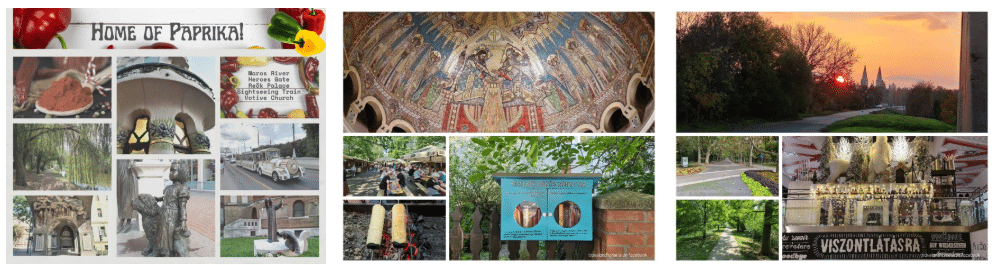
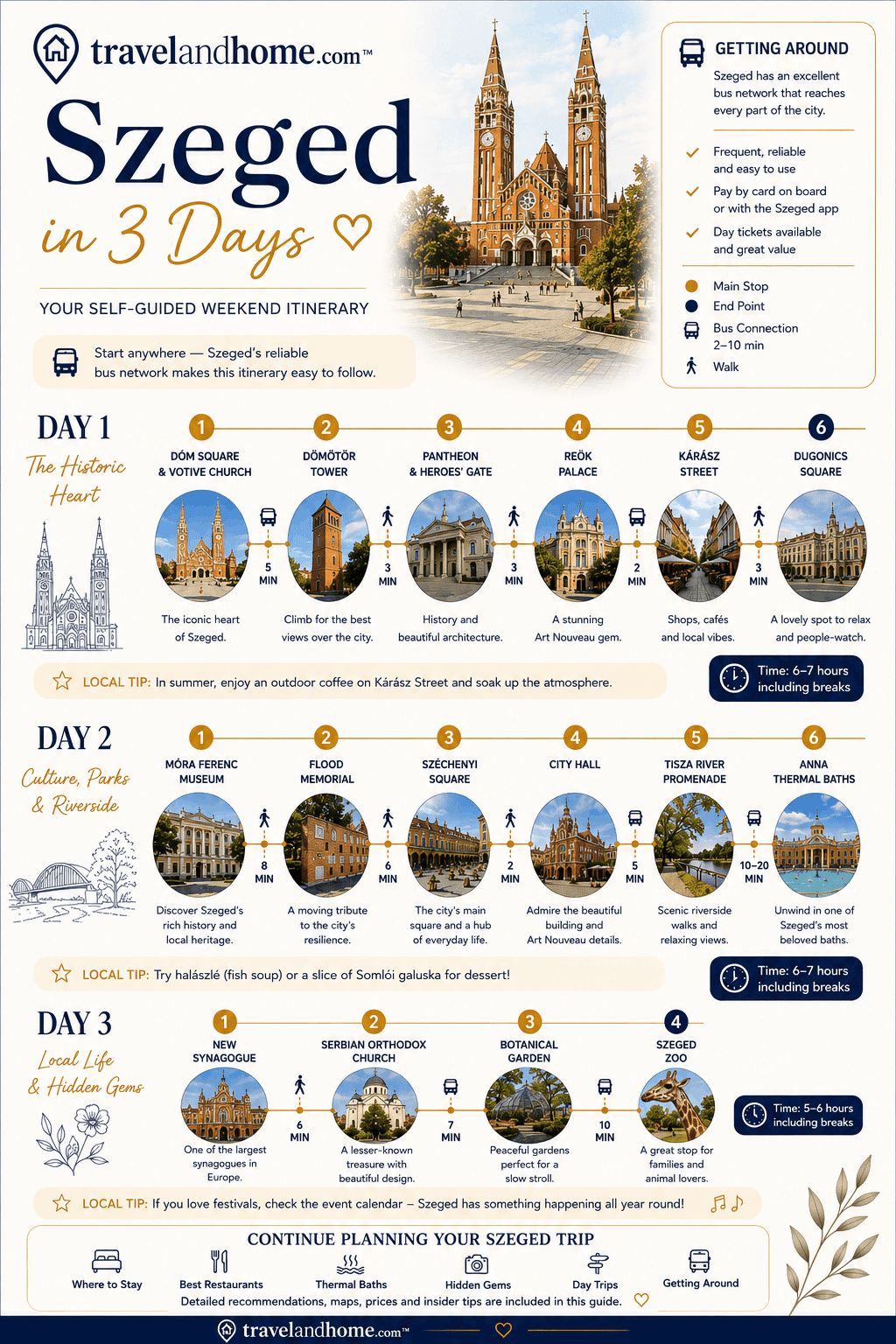
Dóm Square surrounds the Votive Church and Cathedral with its two towers and is home to the world-famous University of Szeged. Here at the University of Szeged, Albert Szent-Györgyi managed to extract vitamin C from the paprika grown in Szeged. The square also hosts the city’s Christmas markets.
It’s also the usual location for Szeged’s annual Christmas market. Think Christmas carols, chimney cakes, boutique-style kiosks, and the big wheel!
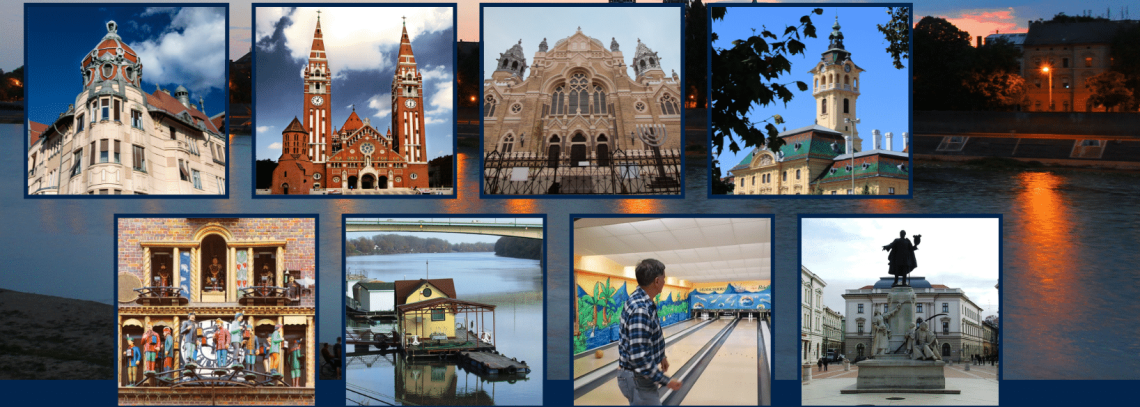
This Neo-Romanesque twin-spired church sits on Dóm Square next to the Dömötör Tower. Construction began in 1913. The outbreak of World War I caused construction to pause. Construction only ended in 1930. Standing tall with its 91-meter-high dome, the Votive Church offers panoramic views of both the city’s architectural gems and its scenic surroundings, drawing both locals and visitors to admire its beauty and historical significance.
“It is a cathedral, a family-friendly church, a destination of pilgrims, a sacred space, an exclusive conference and concert venue, home of the Szeged Open-Air Festival, and an open and receptive community magnet.” -Szegedidom.com
Address: Dóm tér 15
Now for a story with heart—the tale of the Szeged Cathedral, also called the Votive Church. After the devastating Great Flood of 1879, the people of Szeged made a vow. If they could rebuild their city, they would also build a grand church to show their gratitude.
And they kept that promise. Construction began in 1913, though it was paused due to World War I. Finally, the cathedral was completed in 1930. Today, it’s Hungary’s fourth-largest church.
Just look up—you’ll see its massive dome and twin spires. And if you go inside? You’ll find one of the biggest pipe organs in Europe. Now that’s what you call a powerful vow!
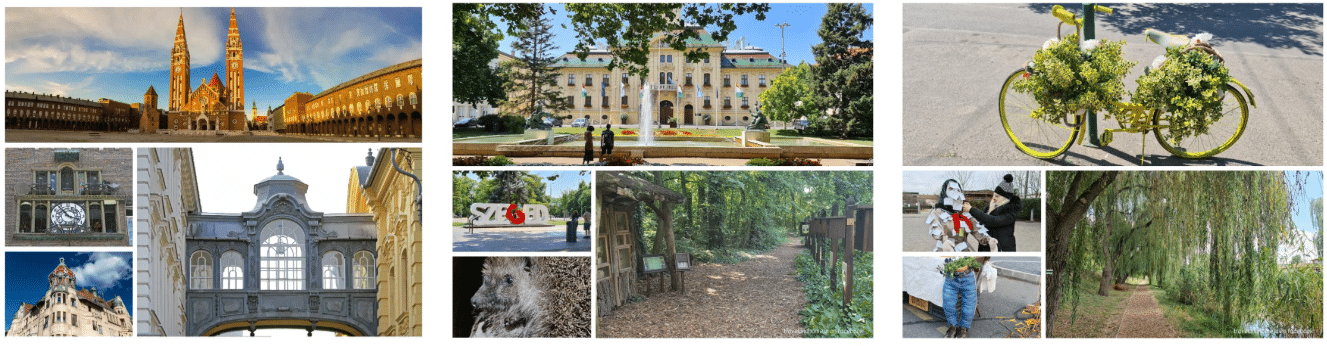
The grand Szeged City Hall (Városháza) is an elegant yellow building with classic features and an old-world clock tower. It dates back to the 18th century and still functions as the city’s administrative hub.
Fun fact: it’s connected to another building by the “Bridge of Sighs”—a covered walkway that crosses over the street.
The City Hall was revamped after the great flood in 1879. Go to the middle window of the staircase where you will see the decorated words “Szeged will be more beautiful than it used to be”. The bells start chiming a few minutes before the clock strikes 12 every hour. Each time, they play a different melody.
Address: Széchenyi tér 10

The devastating flood in 1879 about 60,000 people homeless. Szeged’s new layout and look were shaped by the flood. For example, a raised city center to minimize future flood damage. Some of the grand boulevards in Szeged were named after cities that provided significant aid during the reconstruction following the flood. For example, Bécs utca (Vienna Street) and Párizs körút (Paris Ring Road).
Address: On the corner of Tisza Lajos Krt and Huszár Mátyás Rkp.
The devastating flood in 1879 about 60,000 people homeless. Szeged’s new layout and look were shaped by the flood. For example, a raised city center to minimize future flood damage. Some of the grand boulevards in Szeged were named after cities that provided significant aid during the reconstruction following the flood. For example, Bécs utca (Vienna Street) and Párizs körút (Paris Ring Road).
Address: On the corner of Tisza Lajos Krt and Huszár Mátyás Rkp.
Meander in Dugonics Square, in memory of the Piarist priest and teacher András Dugonics. In 1788, he wrote the first Hungarian novel, namely Etelka. Just like Széchenyi Square, Dugonics Square is known for a wide range of activities and festivals during the summer months.
To quote Luther Vandross: “The best things in life are free”. Many things in life are FREE and breathtakingly beautiful. One of those is a walk on the banks of the river Maros.
Enjoy a game of tenpin bowling at the Bowling alleys and Szeged center – Szeged TE (Szegedi Teke- és Bowlingcentrum – Szegedi TE). They’re on Derkovits fasor 1-5, and you can check availability by telephone – +36 362 401 410.
Anna Thermal Bath is a beautiful, 100+-year-old building where you can enjoy spa, sauna, and traditional massage services. It’s a perfect indoor activity for rainy days. Anna Gyógyfürdő is one of the oldest baths in Hungary, dating back to the late 1800s.
Address: Szeged, Tisza Lajos krt. 24, 6720
Széchenyi Square is one of Szeged’s crown jewels and the largest square in the city. It’s packed with charm, history, and leafy green beauty.
Széchenyi Square dates back to the 13th century, when the castle’s western walls were built along the banks of the Tisza River. Over time, the square has been completely transformed. Today, it’s surrounded by well-preserved historical buildings. The square has a youthful vibe thanks to the many students from the surrounding campuses. In the summer, it’s a bustling hub of activity with events.
Right in the middle of the square is a large green space with well-kept lawns, fountains, flower beds, and plenty of benches. Locals love lounging here, especially in summer. It’s basically Szeged’s outdoor living room.
The square is in the heart of historical Szeged. On the Northwest side, it is bordered by City Hall and City Council Hall.
The National Memorial Hall in Szeged is located in Dóm Square, under the surrounding arcades. The statues and reliefs of the Pantheon, established in 1930 and further developed since then, display outstanding figures of Hungarian history, literature, art, and science.
The Pantheon, a collection of busts and portraits of prominent historical figures, is under the arcades surrounding Dóm Square. Some of the prominent figures are:
Mihály Munkácsy: A renowned Hungarian painter known for his realistic and evocative works, including the famous painting “Christ in front of Pilate.”
Béla Bartók: An influential Hungarian composer and ethnomusicologist, considered one of the greatest composers of the 20th century.
Lajos Kossuth: A key figure in Hungary’s fight for independence during the 1848-1849 revolution, serving as regent-president and later as Governor-President.
Ferenc Deák: A prominent statesman and Minister of Justice, known as the “Wise Man of the Nation” for his role in the Austro-Hungarian Compromise of 1867.
Zoltán Kodály: A celebrated composer, ethnomusicologist, and educator who played a significant role in preserving Hungarian folk music and developing music education.
Sándor Petőfi: A highly esteemed Hungarian poet and revolutionary, known for his powerful and patriotic poems, with “National Song” being one of his most famous works.
Endre Ady: An influential Hungarian poet known for his innovative and symbolic poems, a key figure in modern Hungarian literature.

Most probably the most famous example is the construction of Reök Palace, an exemplary piece of Hungarian Art Nouveau, constructed in 1907 by Ede Magyar. Today, it is a popular place to have coffee and enjoy art exhibitions. Address: Magyar Ede tér 2. Price list HERE.
In addition to the Reök Palace, Ede Magyar, the “Gaudi of Hungary,” designed several Art Nouveau buildings over eight years. For example, the Reformed Palace and Ungár-Meyer Palace. Other architectural beauties are Deutsch Palace, Gróf Palace, Móricz House, Ungar, Mayer Palace, Marer House, and Beregi House.
There are sculptures of great significance everywhere in Szeged.
Prominent is the István Széchenyi statue, paying tribute to the man who helped modernize Hungary (and for whom the square is named).
Then there is the statue of Lajos Kossuth on Klauzál Square and an unparalleled golden tie pin. The pin is held in the gold spectacle of the Ferenc Móra Museum. Lajos Kossuth was a political reformer who inspired and led Hungary’s struggle for independence from Austria. The controversial Kossuth visited Szeged in 1848, giving two speeches to about 10,000 residents. “The cheers, music, and cannons had no length-end,” they wrote of the glorious day. Kossuth gave his legendary speech on this day: “The people of Szeged, the pride of my nation, the pillar of my poor betrayed country, I bow deeply before you!” Later, in 1902, the statue was inaugurated.
A sightseeing cruise on the Tisza River offers a completely different perspective of Szeged. As your boat glides past the city’s elegant riverfront, you’ll enjoy panoramic views of the famous bridges, leafy promenades, and the meeting point of the Tisza and Maros Rivers. It’s a relaxing way to escape the bustle of the city center while learning more about Szeged’s close relationship with one of Hungary’s most important rivers. Sunset departures are especially beautiful, as the golden light reflects off the water and the city’s skyline.
Where to book
The scheduled sightseeing cruises depart from Sétahajó on Huszár Mátyás Rakpart, beneath Roosevelt Square. Cruises typically operate from spring through autumn, with several departures each day depending on the season. Tickets can be booked online through the operator’s website or purchased at the departure point if space is available.
If you prefer something more exclusive, Pontoon Boat also offers private boat cruises on the Tisza, ideal for couples, families, or small groups who would like a more personalized experience on the river.
This is one experience I’d recommend including in your itinerary because it lets visitors appreciate Szeged from an angle that most people never see from land. It fits perfectly into a relaxed afternoon after exploring the city center or before dinner along the riverfront.
On Szent István Square is the Art Nouveau water tower, known to locals as the Old Lady, and built in 1904. The tower is open to the public on the first Saturday of every month between 1 April and 31 October. Climb the stairs to the top (54,9 meters tall) for stunning panoramic views of Szeged.

Szeged’s Jewish Synagogue, completed in 1903, is a stunning architectural masterpiece, blending Art Nouveau and Moorish Revival styles. It ranks among the largest synagogues in Europe and the world’s fourth-largest, accommodating up to 1,300 worshippers. The synagogue’s interior boasts breathtaking stained-glass windows and intricate decorations, creating a mesmerizing ambiance for visitors. A significant symbol of Hungary’s Jewish heritage, the synagogue serves as both a religious sanctuary and a cultural treasure, drawing tourists and locals alike to experience its rich history and spiritual significance. At the New Synagogue, find the biblical commandment in Hebrew and Hungarian that reads “Love your neighbor as yourself”.
Address: Jósika u. 10
The summer is the best time to be in Szeged because of all the festivals. Too many to list here, so check out our feature about all the events in Szeged during the summer, as well as the rest of the year.
The Szeged Zoo is one of the youngest zoos in Hungary and also the largest in area. It primarily specializes in housing rare, endangered species, with a particularly outstanding section of the park displaying South American animals.
Like in the rest of Hungary, Szeged also has a wide range of Thai massage salons. It’s a favorite activity on rainy days, but you need to plan and book well in advance.

The Dömötör Tower is Szeged’s oldest surviving structure, dating to the 11th century. Its Romanesque lower section dates to the 12th century, while the Gothic upper level was added in the 13th century and later rebuilt from original stones in 1926. Once part of the former St. Demetrius Church, it now stands alone in Dóm Square before the Votive Church. Its architectural style echoes towers found in southern France and former Byzantine territories.
Be there at 12h15 or 17h45 to hear the tunes of this unique clock, dating back to 1936.
Albert Szent‑Györgyi’s story in Szeged reads almost like a local legend. He was the city’s honorary citizen, a brilliant biochemist, and Hungary’s only Nobel laureate whose prize‑winning work was actually done *in* Hungary. Beyond the lab, he led the Medical Faculty, served as Rector of the University, and even chaired the Rotary Club that now carries his name.
Today, there’s a warm little memorial room dedicated to him inside the 1911 Dean’s Office building—an art relic since 2008. Alongside his legacy, visitors also stumble upon a fascinating collection of pre‑Columbian statues and tools from South America, gifted by Egon Diczfalusy, a Hungarian professor living in Sweden. It’s a small space, but it feels like stepping into a quiet corner of Szeged’s scientific soul.
The Church of St. Nicholas is a Serbian Orthodox church in Szeged.
Here you’ll see a traditional Orthodox interior. The Rococo iconostasis, embellished richly with gold, is one of the most beautiful pieces in Hungary. The church is on the northern side of Dóm Square towards the River Tisza.
Address: Somogyi u. 3
Serbian Orthodox Church – All You SHOULD Know Before Going …
Kárász Utca is where the heart of Szeged beats.
It starts right at Széchenyi Square, one of the city’s largest and most iconic open spaces.
As you step onto Kárász Utca, you’ll be greeted by a charming bronze statue of two figures in Renaissance carnival costumes. They stand at the entrance like playful hosts, welcoming you into the pedestrian zone.
The street is lined with architectural gems, stylish shops, and buzzing cafés; it’s where locals come to stroll, shop, do people-watching, and soak up the vibe.
Kárász Utca connects Széchenyi Square to Dugonics Square, tying together some of the city’s most vibrant public spaces.
The street is named after the Kárász family, who played a big role in the city’s past.
Kárász Utca and Klauzál Square won the Europa Nostra Award for preserving their architectural charm after their major makeover in 2003.
Szeged’s Botanical Garden is one of those places that quietly steals your heart. It’s peaceful, lush, and full of little surprises, from the Japanese garden to the tropical greenhouse and the famous giant Victoria amazonica water lily that blooms in summer. Locals love it as a slow‑wandering, shade‑filled escape, and visitors usually walk away saying it was far more beautiful than expected.
Address: 6726 Szeged, Lövölde út 42.
Not quite in summer, but a highlight of the year.
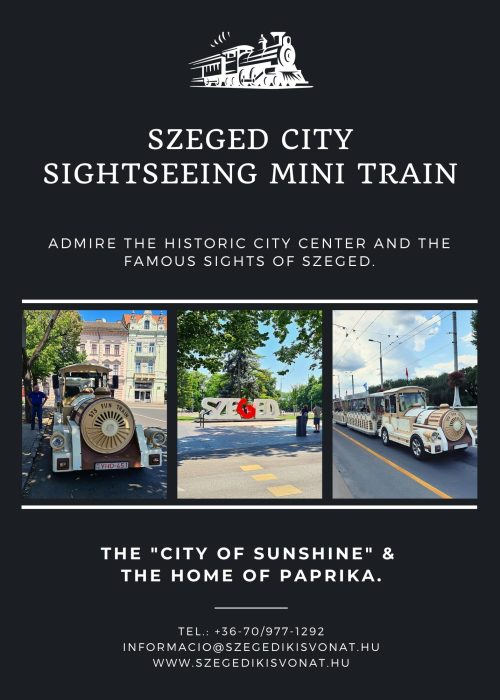
Szeged’s tourism train shows you all the main attractions with Hungarian and English audio.
Travel and Home Tips:

Hungarian food is known for its use of paprika, onion, and black pepper. Chicken, pork, and beef are standard meat dishes. You seldom get lamb unless it is a special occasion such as Christmas or Easter. Classic Grill in the old town is the place to enjoy lamb dishes. Or if you love curry, the Taj Mahal has delicious lamb curries. Fish lovers may find restaurants that offer salmon, but seldom fresh fish from the big ocean. Since Hungary is a landlocked country, I prefer to enjoy fresh fish when I visit coastal places in Cape Town, Italy, or Portugal (for example).
>> Check out our feature about what to eat and drink while in Hungary.
If you like lamb meat, Classic Grill restaurant in the middle of town is the place to go. It’s a Serbian restaurant, so there’s lamb. Otherwise, lamb meat is scarce in town. Emmarozs in ÜjSzeged (they’re also in the old town of Szeged) has super tasty quiche and coffee.


The restaurant at the Novotel Hotel in Szeged, Novo Square Restaurant, is a hidden gem! They offer a mix of international cuisine and traditional Hungarian dishes, all while providing a beautiful view of the Tisza River. Dinner outside during summertime may not be wise because of the mosquitoes. But lunch outside is great no matter the season.
After living in Szeged for the past seven years, I can honestly say this is a city that reveals itself slowly. It may not have the crowds of Budapest, but that’s part of its charm. Take your time, wander beyond the main sights, enjoy a coffee on Kárász Street, stroll along the Tisza River, and don’t be surprised if you find yourself extending your stay just to experience a little more.
I hope this guide helps you discover not only the city’s famous landmarks but also the quieter moments that make Szeged such a wonderful place to visit. Whether you’re planning a weekend getaway or using Szeged as a base to explore southern Hungary, I wish you a trip filled with memorable experiences, great food, and warm Hungarian hospitality.
Have you visited Szeged, or is it on your travel wish list? I’d love to hear about your favorite places, hidden discoveries, or any questions you have in the comments below. Your experiences may also help future readers plan an unforgettable visit.
Sharing the places I’ve come to love. – Arina ♡
Check if you need a visa to visit Hungary.