
Home - Travel Destinations - Karlovy Vary, Czech Republic: 13 Best Things to Do + Where to Stay
If you click on links we provide, we may receive compensation.
Karlovy Vary is world‑famous for its mineral springs since the Middle Ages. The city, also known as Karlsbad (German) or Carlsbad (English), was founded in 1370 by Emperor Charles IV.
The town’s origins are wrapped in legend: while out hunting, one of his dogs is said to have tumbled into a steaming spring, revealing the healing waters that gave the town its name (vary means “hot spring”).
From the 18th century onward, Karlovy Vary became a magnet for Europe’s elite. Royals, artists, and aristocrats flocked here to “take the waters,” cementing its reputation as one of the continent’s most glamorous spa destinations.
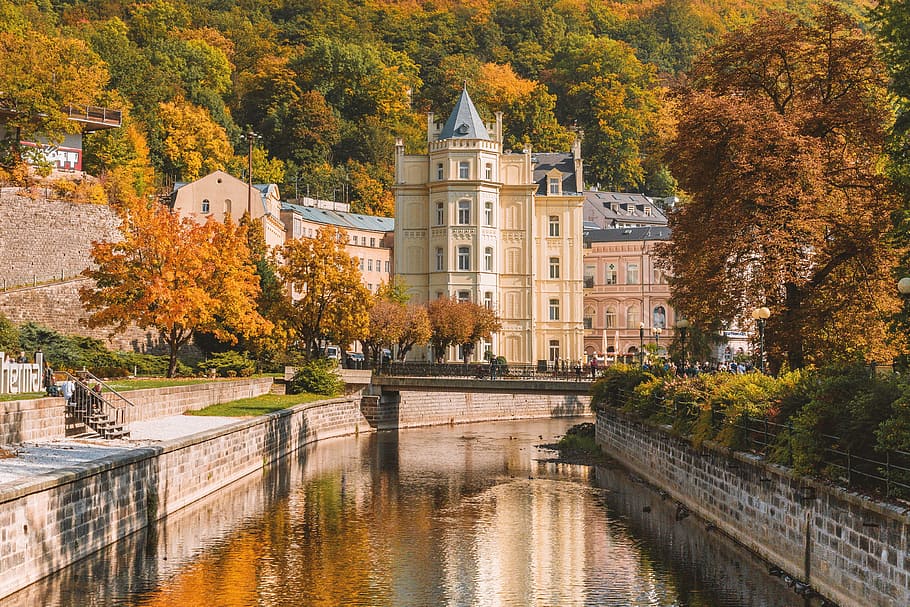
Karlovy Vary, the elegant resort town of the Czech Republic, is known for its mineral springs, glassware, and Belle Époque architecture.
Karlovy Vary is not only the most famous spa town in the Czech Republic but also the largest. With more than a dozen hot springs and about 300 smaller springs, the city is a very popular tourist attraction. Known as the jewel of the West Bohemian Spa Triangle, it sits conveniently about 130 km west of Prague.
It was a German-speaking city before World War II. Thereafter, Czech settlers moved in, and today Czech is the official language.
Karlovy Vary means “Charles’ Bath”, named after Charles IV, King of Bohemia and Holy Roman Emperor.
From ancient glory to today, with its colorful, whimsical architecture, it is no wonder it was the setting for many scenes in the 2006 James Bond movie, Casino Royale. For example, the casino setting in Casino Royale was at the beautiful Lázně 1 (Spa 1) building.
Did You Know?
Every late June and early July, West Bohemia comes alive with the Karlovy Vary International Film Festival—one of Europe’s most prestigious cinematic events. First launched in 1946, the festival has grown into a cultural highlight, ranking alongside Cannes, Berlin, and Venice. Its top honor, the Crystal Globe Award, celebrates outstanding achievements in world cinema and has become a symbol of Karlovy Vary’s global reputation as a hub for film lovers.
For decades, the spa city was a favorite destination for Russian aristocrats and elites, and later for middle‑class tourists. Russian was widely spoken in hotels, restaurants, and shops, and the city even became known as a “Russian spa capital” in Europe. Moser glassware, Orthodox churches, and Russian cultural events reinforced this connection.
Before 2022, Russians and other CIS visitors made up a significant portion of the tourist flow. But after 2022, the numbers declined dramatically due to sanctions and visa restrictions limiting Russian travel to the EU. The economic downturn in Russia made international travel less affordable.
Today, more visitors from Germany, Poland, Slovakia, and Austria help fill the gap left by Russian tourism. Ukrainians displaced by the war also form a noticeable presence, both as temporary residents and tourists.
Yes, as Russian tourism declined after 2022, English has become more prominent as the “neutral bridge language” for diverse European and overseas visitors. Most signage in Karlovy Vary’s tourist areas (colonnades, museums, spas) includes English translations. It’s safe to say that today, English is the default international language for tourism and services in Karlovy Vary.
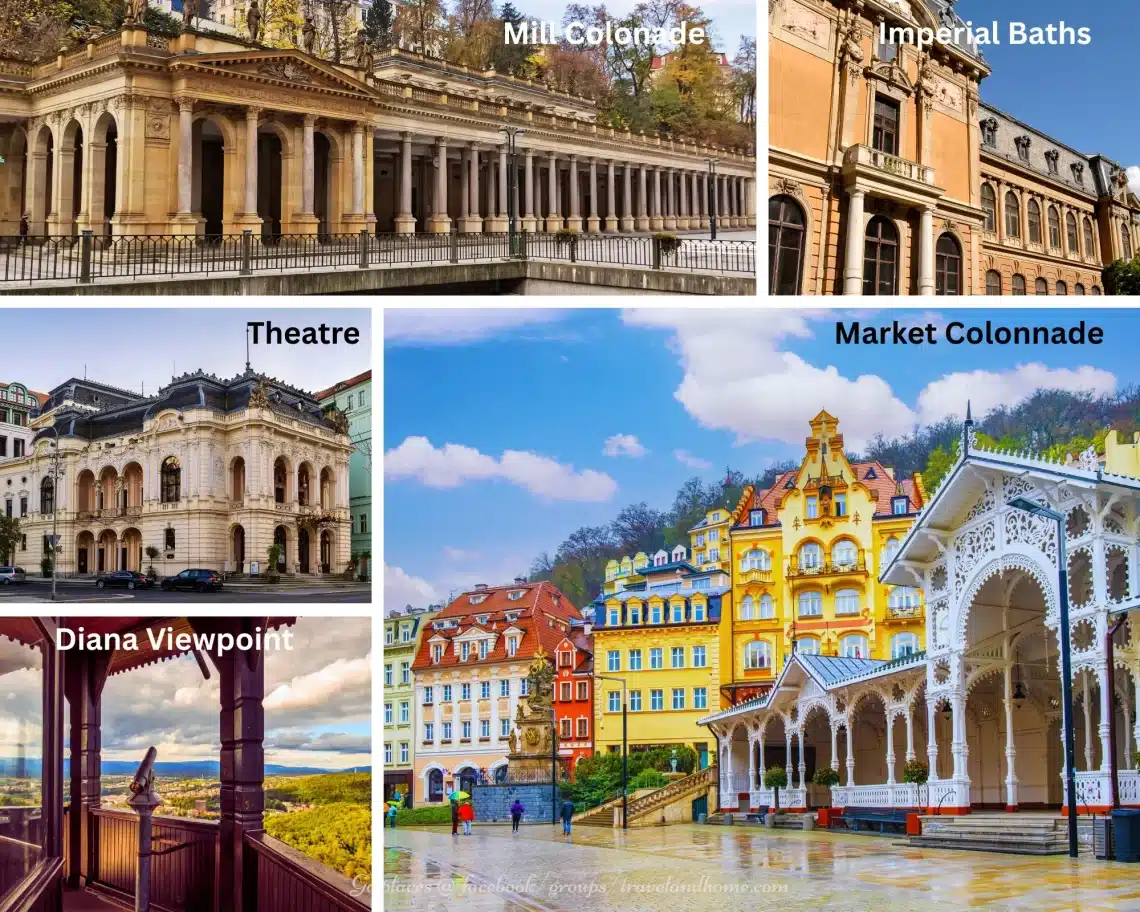
Stretching gracefully along the River Teplá, the Mill Colonnade is Karlovy Vary’s largest and most impressive colonnade. Designed by Josef Zítek—the architect behind Prague’s National Theatre—it was built between 1871 and 1881 in a striking Neo-Renaissance style.
This grand gallery measures 132 meters (430 ft) in length and 13 meters (43 ft) in width, with a beautifully coffered ceiling supported by 124 Corinthian columns. Inside, visitors can sample water from five different mineral springs, each with temperatures rising above 50°C (120°F).
Adding to its charm, statues at both ends of the colonnade represent the twelve months of the year, making it not just a spa destination but also a cultural landmark worth lingering over.
Once the most lavish building in Karlovy Vary, the Imperial Baths—known locally as Kaiserbad or Lázně I—stand out with a theatrical elegance that feels more like an opera house than a medical spa. Constructed between 1892 and 1895, the building showcases a striking Neo-Renaissance façade complemented by exquisite Art Nouveau details both inside and out.
A symbol of the city’s golden spa era, the Imperial Baths remain one of Karlovy Vary’s most iconic architectural treasures.
Built between 1884 and 1886 by renowned Viennese architects Ferdinand Fellner and Hermann Helmer—masters behind dozens of theatres across Europe—the Karlovy Vary Theatre is a gem of cultural architecture.
Step inside to admire its lavish interior, where you’ll find paintings by Gustav Klimt, his brother Ernst, and Franz Matsche. Their most remarkable collaboration is the theatre curtain, featuring a joint self-portrait of all three artists.
Today, the theatre continues to enchant audiences with a diverse program of concerts, operas, and theatrical performances, making it a must-visit for lovers of art and culture.
Just behind Karlovy Vary’s famous Grand Hotel Pupp, at the southern end of Stará Louka, you’ll find the lower station of the funicular railway. In operation since 1912, this charming ride climbs 167 meters (550 ft) over a distance of 435 meters (1,425 ft), carrying visitors up the Hill of Friendship.
At the summit awaits the Diana Viewpoint, offering sweeping panoramas across the spa town and its surrounding hills. It’s one of the best spots to take in Karlovy Vary’s beauty from above—perfect for photos, a quiet pause, or simply soaking in the scenery.
The Market Colonnade is one of Karlovy Vary’s most charming landmarks—a delicate white wooden structure built in 1883–84 in the Swiss chalet style by famed Viennese architects Ferdinand Fellner and Hermann Helmer. It stands on the site of the former town hall, demolished in 1879, and has retained its fairytale look ever since.
Inside, visitors can taste water from two mineral springs, making it both a picturesque and practical stop on any spa walk. Though the colonnade underwent a major reconstruction in 1991–92, it carefully preserved its original 19th‑century character, ensuring it remains a beloved icon of the town.
Did You Know?
The Czech Republic is known for its very own herbal bitters liqueur, namely Becherovka. At the Jan Becher Museum, you’re going back to 1807 when the pharmacist Jan Becher concocted the herbal bitters drink with water from the city’s springs. To date, the same recipe is used. Becherovka is also preferred by many locals as a digestive, to be enjoyed after dinner.
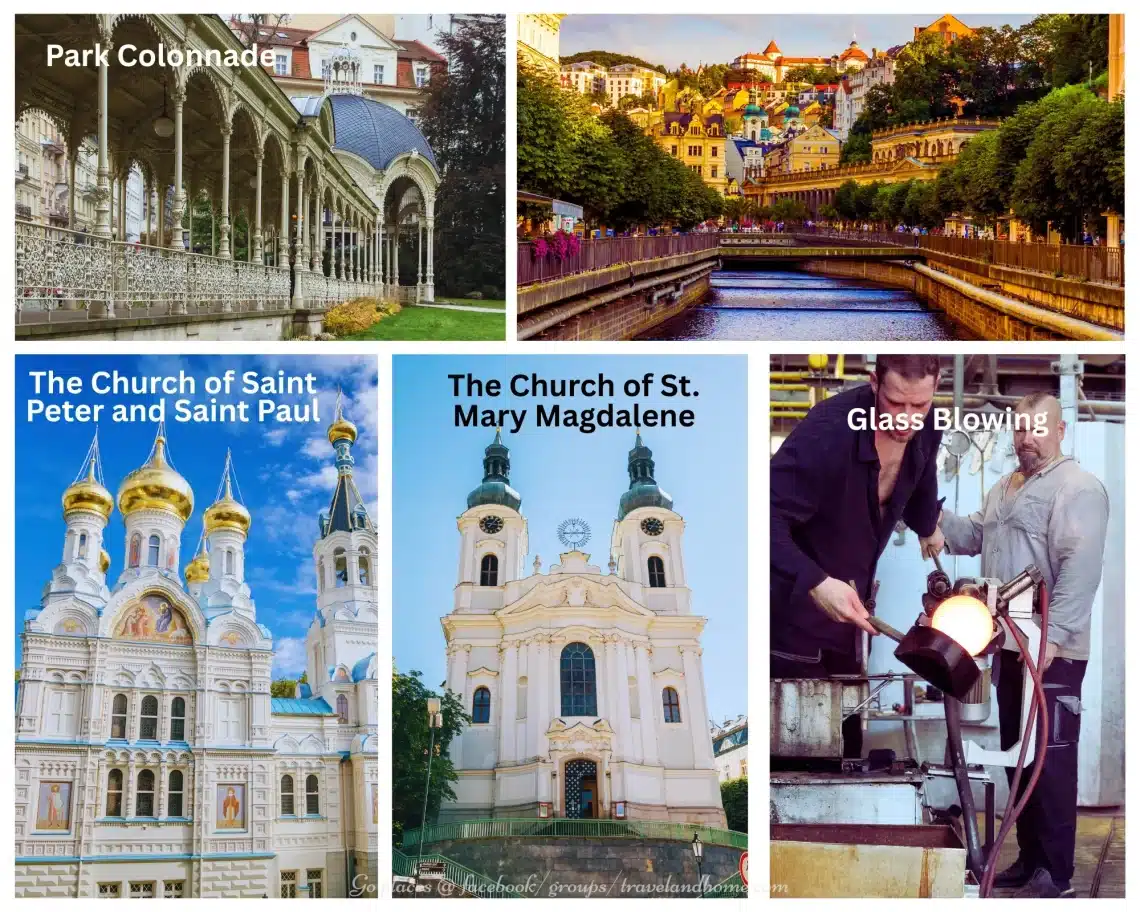
In the heart of Karlovy Vary, on the west bank of the River Teplá, you’ll find the elegant Park Colonnade. Built in 1880–81 by Viennese architects Ferdinand Fellner and Hermann Helmer, this painted wrought‑iron structure is adorned with sculpted columns and ends in two graceful pavilions.
Set within the leafy Dvořákovy Sady gardens, the colonnade is both a charming architectural gem and a peaceful spot to pause during a stroll through the town. Its ornate design and garden setting make it one of Karlovy Vary’s most picturesque landmarks.
Built between 1893 and 1897, the Church of Saint Peter and Saint Paul is one of Karlovy Vary’s most striking landmarks. Its five gilded domes and vibrant, richly decorated exterior make it instantly recognizable as a masterpiece of Russian Orthodox architecture.
Inside, the church is equally ornate, adorned with icons, artworks, and gifts donated by wealthy Russian aristocrats who frequented Karlovy Vary during the 19th century. Today, it stands among the largest Russian Orthodox churches in the world—a lasting testament to the city’s historic ties with Russia’s elite.
Built between 1732 and 1737 by renowned architect Kilian Ignaz Dientzenhofer, St. Mary Magdalene’s Church is considered one of the finest examples of Baroque architecture in Bohemia. Its distinctive oval floor plan and single-aisled design create a spacious, light-filled interior that feels both grand and inviting.
The high altar, completed in 1752, features a striking image of Mary Magdalene, flanked by Jakob Eberle’s 1759 sculptures of St. Augustine, St. Jerome, St. Peter, and St. Paul. Visitors will also find a Gothic Madonna, richly decorated side altars, an elegant dome, and magnificent galleries that add to the church’s splendor.
Outside, the wavy façade with twin towers and a sweeping semi-circular stairway makes the church one of Karlovy Vary’s most iconic landmarks—beautiful both inside and out.
Czech craftsmanship in glass, crystal, and porcelain has long been admired across Europe for its elegance and quality. Karlovy Vary is especially renowned thanks to Moser, one of the world’s most prestigious glassmakers, whose creations are prized by collectors and royalty alike.
The town also has deep roots in porcelain production—the first local factory opened in the early 19th century—cementing Karlovy Vary’s reputation as a hub for fine china and exquisite glassware.

In July–August 1812, Beethoven lodged in a house called Boží oko (“God’s Eye”), which once stood where the Grandhotel Pupp is today.
A commemorative plaque at the hotel marks his stay.
Anecdote: During this visit, Beethoven was simultaneously working on major compositions and corresponding with Goethe — whom he met in Karlovy Vary that same summer. Their encounter is legendary: Beethoven walked boldly through town while Goethe politely stepped aside for nobility, highlighting their very different temperaments.
A portrait relief on the “Beethoven House” recalls his presence in the spa quarter.
This area was central to the aristocratic life of Karlovy Vary, where Beethoven mingled with Europe’s elite.
Anecdote: Beethoven was known to be restless and often wandered the spa promenades, scribbling musical ideas while taking the waters.
A forest trail named after him winds through the spa woods.
Anecdote: Locals say Beethoven loved walking in nature here, finding inspiration in the quiet hills above the town — a habit he kept throughout his life.
In 1929, sculptor Hugo Uher created a monumental granite and bronze statue of Beethoven in front of Parkhotel Richmond.
Restored in 2012 for the 200th anniversary of his visit, it features allegorical reliefs celebrating his music.
Anecdote: This is considered one of the most beautiful Beethoven memorials in Europe, symbolizing Karlovy Vary’s pride in hosting him.
On August 6, 1812, Beethoven gave a benefit concert in Karlovy Vary’s Czech Hall, joined by violinist Giovanni Battista Polledro.
The proceeds went to victims of a devastating fire in Baden near Vienna.
Anecdote: This concert is remembered as one of Beethoven’s rare public performances during his later years, showing his generosity despite personal struggles.
Start at Grandhotel Pupp → stroll through Lázeňská/Zahradní Street → walk up Beethovenova Stezka → finish at the Richmond Monument.
Along the way, pause at cafés or colonnades to imagine Beethoven himself sipping mineral water and sketching musical ideas.
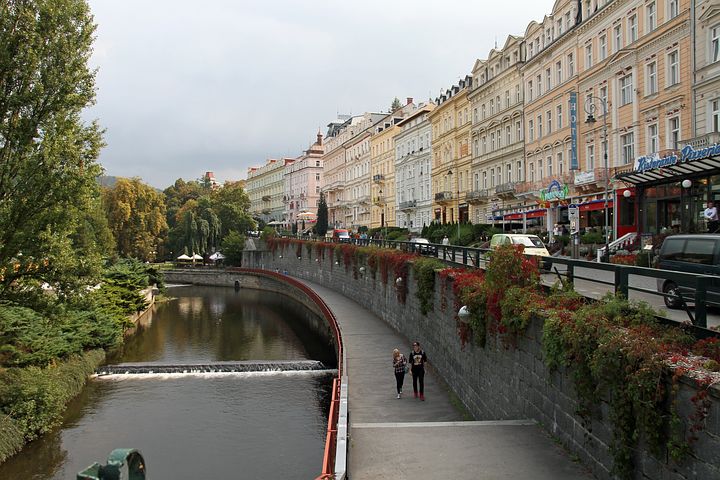
Stará Louka is the city’s most famous and prominent shopping street. Here you’ll find anything from high-end boutiques to coffee shops.
Wander along the river Teplá and take in the beautiful setting. Then, do another walk in this calm and relaxing setting. However, plant it around sunset for another charming view.
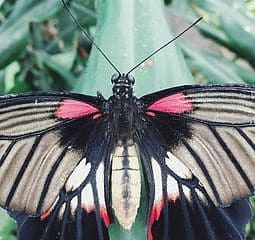
Discover the most beautiful and exotic butterflies from around the world in a tropical garden setting. For instance, butterflies from Thailand, from the Philippines, or from the rainforests of South America or Mexico.
As you meander amongst more than 300 colorful beauties fluttering around you, you will be fascinated by the range of colors and sizes. For example, some butterflies have a wingspan of up to 20 cm!
Also, you get to do some souvenir shopping at the pretty butterfly-themed shop. Make sure you have enough cash with you because they only take cash as payment.
Travel Tip –
If you’re already heading up to the Diana Viewpoint, the Butterfly House is a charming add-on — especially for families, photographers, or anyone who delights in nature’s details. On its own, it’s brief, but as part of the Diana complex, it rounds out the visit beautifully.

Deer Jump is both a lookout and a viewpoint, with historical charm, legends, and sweeping views over the spa center and the Teplá River valley. It’s one of the town’s oldest scenic structures, built in 1804. The wooden lookout pavilion (also called Mayer’s Gloriette) sits on a rocky promontory west of Karlovy Vary’s center, at about 472 m elevation.
Legend has it that Emperor Charles IV’s hunting party chased a deer here. The deer leapt from the cliff into a hot spring (today’s Vřídlo), leading to the discovery of Karlovy Vary’s healing waters.
After much controversy, a statue of a chamois was placed here in 1851, after Baron August von Lützow argued that only a chamois could manage such terrain. This statue became an icon of Karlovy Vary.
Guided tours are often offered in English alongside Czech, German, and Russian.

Travel Tip –
Keep in mind that parking is available but limited in the historic center. So when you book a place to stay, it’s best to book hotels with parking.
In the early 20th century, Karlovy Vary lacked sufficient capacity for spa accommodation. Then, local entrepreneur Alfred Schwalb identified an opportunity to build a “fairy-tale” international grand hotel with exquisite views.
Combined with a transport solution in the form of the single-track funicular up a 127-meter-long tunnel, construction started, and the hotel opened its doors in June 1912.
Not only was Spa Hotel Imperial the venue of the World Chess Championship in 1923, but it also has an impressive guest list:
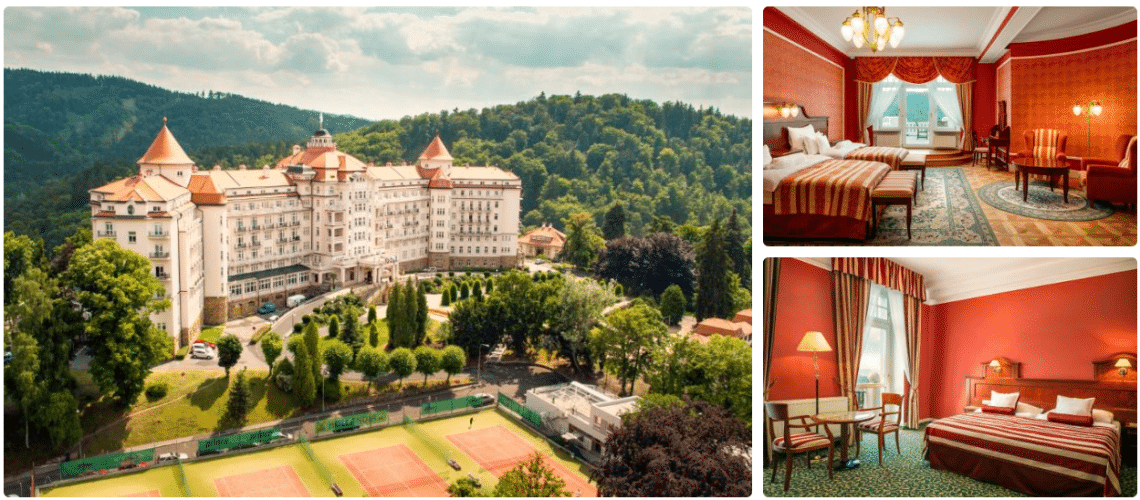
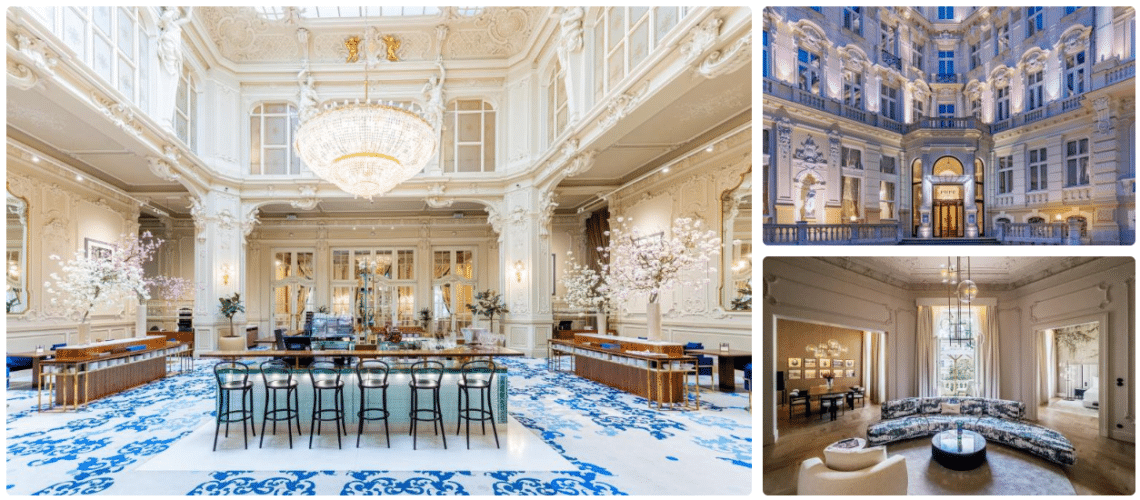
An entertainment establishment was previously on the same site, constructed in 1701. It was demolished in 1892, and the modern hotel that stands today is the Grandhotel Pupp. Between 1892 and today, the hotel has had several name changes. The government even nationalized it. That is, after the Second World War. Subsequently, the hotel was privatized again, and after extensive restorations, it is a treasure.
Did You Know?
Karlovy Vary is on the list of the 11 Great Spa Towns of Europe, read more…
Karlovy Vary is more than mineral springs and spa rituals — it’s a town layered with history, legends, and cultural gems waiting to be discovered. Whether you’re strolling the colonnades, following in Beethoven’s footsteps, or simply enjoying a coffee by the Teplá, every corner has a story to tell.
💬 Now it’s your turn! Have you visited Karlovy Vary, or is it on your travel wish list? Share your favorite experiences, tips, or questions in the comments below — your insights might inspire someone else’s journey.
